

Rob Behrens CBE took up the office of Ombudsman in April 2017. As he prepares for retirement from this post in March 2024 let us take a look at whether his tenure has lived up to the promise of what a ‘real ombudsman’ can achieve.
Behrens set out his intentions during his pre-appointment inteview with PACAC on 18th January 2017. He has had the best part of seven years to achieve these goals. As the PACAC committee searches for his replacement, it would be beneficial to determine which promises have been delivered and which were nothing but hot air.
Behrens was transferring to PHSO from his role as the Independent Adjudicator and Chief Executive of the Office of the Independent Adjudicator for Higher Education (OIA). A position he held since 2008. He describes the poor state of that organisation when he took over.
The key issue is that I have 10 years’ experience as an ombudsman and, in higher education. I took over an organisation that had done very well at the beginning but needed to become more open, more outward facing, more transparent, and needed to have a conversation not only with universities but with users of the service and complainants, to make sure that the complaints process was user friendly and rigorous in terms of the investigations that were taking place.
Over a period of four years after I joined, I set about three national consultations called the Pathway process, which set out to listen to stakeholders and users about their experience of the OIA. What we got from that process was an acceptance that the OIA performed an important function but, in the view of users and stakeholders, it was insufficiently user friendly, insufficiently transparent, too slow in resolving complaints and not sufficiently flexible in its approach to cases.
https://committees.parliament.uk/event/10131/formal-meeting-oral-evidence-session/
Behrens likes to see himself as something of a troubleshooter. Shortly after taking on the role of PHSO Ombudsman he described to Civil Service World the issues he faced there.
Behrens told CSW the organisation had been through a “traumatic two years”, but that the strength of PHSO’s “superb” staff had shone through.
“It was quite clear talking to people throughout the organisation and outside in preparation for coming that there had to be reassurance and a plan for moving forward,” he says of the episode. “The reassurance is about having a leadership that sets out very clearly what the priorities of the organisation are, so we have to be first and foremost an ombudsman service that resolves complaints for groups and individuals.
https://www.civilserviceworld.com/in-depth/article/lessons-in-listening-phso-rob-behrens-doesnt-just-want-to-be-the-ombudsman-for-bad-news-and-recalls-working-with-cyril-ramaphosa
Just as Behrens set about his Pathway project at OIA, he began his tenure at PHSO by setting up new complaint standards for the NHS. This was a major project, launched in March 2021 (four years after his appointment) and they were still to be rolled out across the NHS in March 2023.
Our next step is to roll out Complaint Standards materials and training across the wider NHS. When doing so, NHS staff can be confident that the Standards have been tried and tested with their peers.
We will also begin to refer to the Standards in our casework. This will focus on identifying good practice and how local complaints handling can be improved.
https://www.ombudsman.org.uk/news-and-blog/blog/nhs-complaint-standards-value-good-complaints-handling
It has taken until October 2023 for PHSO to produce the standards for government bodies.
The pace of this work means that evaluation of these new complaint standards will occur well after Rob Behrens has left office. It could be argued that time and money could have been better used by rolling out the existing guidelines, My Expectations, as commended in the Health Select Committee report of 2015 and supported in the government response to that paper.
We welcome the work that has been done to produce what is essentially a best practice guide to first-tier complaints handling. There can be no excuse now for any health or care organisation not to have an appropriate mechanism in place to deal with concerns and complaints. It represents an important first step towards an overarching, single access-point complaints system. (Paragraph 79)
Government response: We agree that the work recently published by the Parliamentary and Health Service Ombudsman, the Local Government Ombudsman and Healthwatch England [“My Expectations for Raising Concerns and Complaints”] clearly defines universal expectations for what good complaints handling should be like. It has made clear what is required of organisations in respect of complaints handling, and now informs CQC’s inspections.
Rob Behrens stated that his primary purpose was to resolve complaints for groups and individuals. Let us look at his record on this key issue.
During his time at OIA, Behrens oversaw a low uphold rate for complaints about Higher Education Institutions (HEI) Just 4% were found to be fully justified and 73% were rejected as either unjustified or not within their remit. final report 2016/17 (p9).
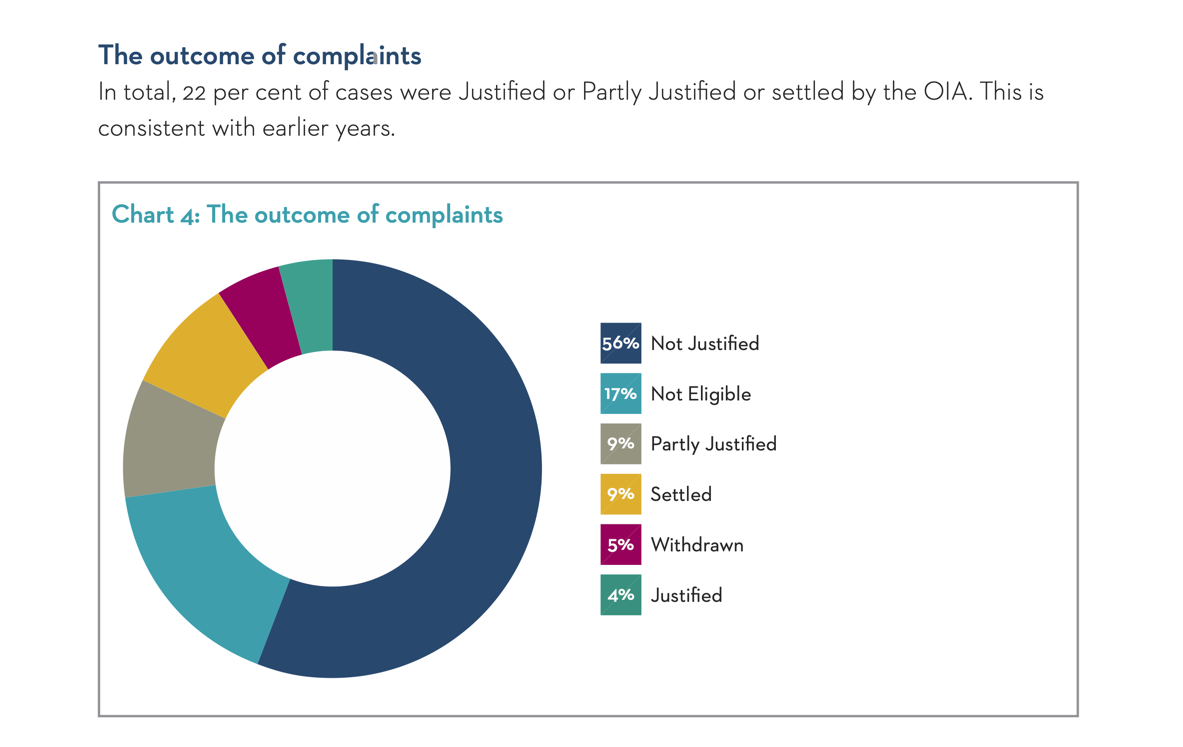
A study by Dr David Hockey ((investigative criminologist & researcher) published in March 2020 ‘The Ombudsman Complaint System; a Lack of Transparency and Impartiality’ found this uphold rate to be significantly biased towards the institutions.
Although the OIA’s annual findings are statistically significant in favour of the providers’, p < 0.05 (see OIA annual reports 2018), in the rare event of the OIA finding a complaint to be ‘justified’ (about 4–6% of complaints annually) or ‘partly justified’ (about 11%), the OIA will suggest a financial figure to the provider to pay to the complainant by way of compensation.
https://link.springer.com/article/10.1007/s11115-020-00469-2 paywall
This perceived bias caused considerable disquiet among service users, as described by Hockey in his study.
“Many students were angry and frustrated that in the event of a conflict of evidence, they perceived that the HEI account was accepted and their own rejected for no satisfactory reason that they could see.” (Price and Laybourne 2009).
In addition to this, the OIA refuse to make visible the feedback comments of most complainants whilst publishing a few examples which they select, thus through impression management, a misleading picture is presented about how students perceive the OIA. However, the overwhelming number of feedback examples that have been published independently of the OIA, do not support the OIA’s assertion that they are without bias towards the providers.
https://link.springer.com/article/10.1007/s11115-020-00469-2 paywall
They also converge on similar points (i.e., that the OIA ignore evidence against HEI ‘s on issues of substance, which in turn serves to justify their decision to agree with HEI’s), almost two thirds of students felt that important points were not addressed by the decision maker at the OIA (Price and Laybourne 2009).
Any investigation by PACAC into Behrens’s previous record would have determined his low uphold rate and lack of public confidence in OIA decisions. Once in office at PHSO, he followed a similar agenda. Note the significant fall in both investigations and upholds from 2017.
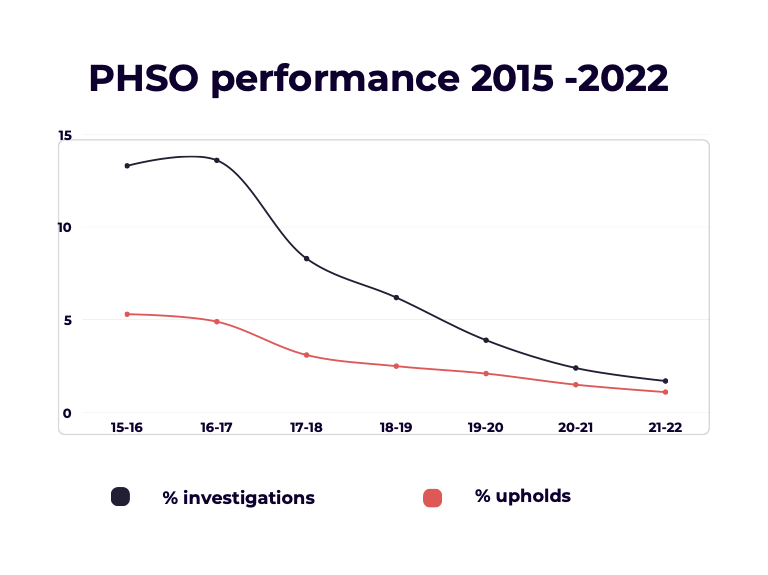
Behrens often changed definitions or ways of recording data, making it difficult to compare his performance with previous years. Shortly after his appointment, initial assessments of complaints were redefined as primary investigations. This gives the impression that a significant number of complaints are investigated by the Ombudsman when in reality this stage only records those cases dismissed from full investigation. At the same time, Behrens oversaw a steady decline in detailed investigations (which are required for uphold) from 13.6% prior to his appointment to just 1.7% of all complaints in 2021/22. Equally, there has been a decline in the uphold rate from 4.9% to just 1.1% of all complaints. Of those cases that are listed as ‘resolved’ fewer than 10% are resolved with a positive outcome for the complainant and none of these cases have received a full investigation.

Remarkably, at interview, Behrens was in praise of the Ombudsman investigating more complaints.
One of the good things that PHSO has done, particularly since the Titcombe affair, has been to increase the number of cases that it has taken on, and I think that is absolutely right. But there has to be a very clear clarity of purpose about what can be investigated and what should be investigated, and we have to share that with users.
https://committees.parliament.uk/event/10131/formal-meeting-oral-evidence-session/
More recently he has shared with users the fact that the Ombudsman will no longer investigate ‘minor’ NHS complaints, as outlined in a recent service update.
‘Relatively minor’ means:
- annoyance, frustration, worry or inconvenience – usually from a one-off incident
- a small amount of distress or minor pain – which usually lasts a short time.
Given that you cannot make a complaint to the Ombudsman until you have completed the NHS first-tier stage, do people sacrifice a considerable amount of time and effort for such relatively minor issues in the first place? However, without a full investigation and usually within seven days of receiving the complaint, the Ombudsman has given himself the powers to dismiss the case as ‘minor’.
It would appear that Behrens’s fine words have not been met with equally fine actions when it comes to carrying out investigations.
This low investigation rate has failed to build public confidence and in line with Hockey’s findings on OIA, reports that are collated outside of the organisation show high levels of public dissatisfaction. Trustpilot Reviews.

Here is a typical example:

Hockey describes OIA and PHSO as ‘closed’circuit’ complaint organisations as they are self-regulating and enjoy wide-spread discretion to act as they see fit.
In that sense, these self- regulating closed-circuit complaint organisations, although independent in some respects, are effectively annexed to the institutions they adjudicate upon and so form part of that eco-system, with many individual adjudicators and members of Governance boards originating from those institutions …
https://link.springer.com/article/10.1007/s11115-020-00469-2 paywall
Returning to his pre-appointment statements we can see that Behrens intention was to improve stakeholder and user opinion by decreasing the time taken to handle investigations.
There is a need to understand the perspective of the staff in the organisation, about their take on how things are, and there is a need to agree together a common approach to deal with the deficits in stakeholder and user opinion of the organisation. That is the first thing.
The second thing is to try to bring down the average time it takes for complaints to be processed by the organisation. As I understand it from the annual report, the average handling time at the moment is 263 days. As an ombudsman, and with respect to those who are involved in it, that is far too long. I notice that in 100 days of those 263 days nothing happens, so there are backlogs and queues. That is part of the frustration that users feel about coming to the PHSO, so those are two critical things.
https://committees.parliament.uk/event/10131/formal-meeting-oral-evidence-session/
During 2016-17, 526 investigations, 12% of the total, took us more than a year to complete, compared to 10% of the total number of investigations last year.
https://www.ombudsman.org.uk/sites/default/files/PHSO_Annual_report%20and%20accounts_2016-17.pdf P20
By 2022/23 we can see that had risen to 23% of investigations taking over a year (p38).
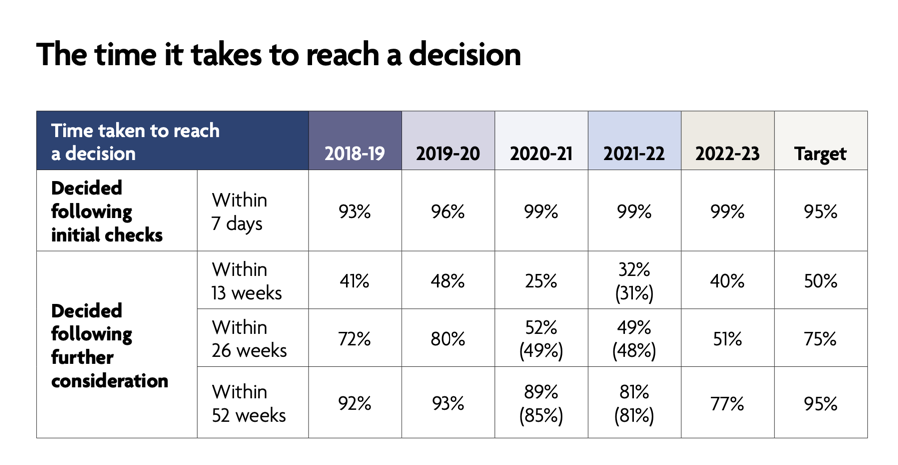
We must bear in mind the effect of the pandemic lockdown in 2020/21 but we must also consider that in 2021/22 PHSO staff were investigating just 612 cases compared to 4,239 in 2016/17. We also learned from a recent Service Update that;
Current wait times are:
- up to six months for complaints about the NHS
- up to 5 months for complaints about UK Government departments.
It would appear that despite a significant reduction in the number of cases investigated under Behrens administration, far too many of them are still suffering from lengthy delays. Including the 3.6 million women waiting on the outcome of the 50s women’s complaint against the DWP. A complaint taken up by the Ombudsman in 2017 which is still to reach a final conclusion.
Behrens may claim a lack of funding and staffing but according to this FOI, PHSO saw an increase in funding to £41.8m in 2021 and now enjoys a larger staff quota than at any other time, partly because jobs are now duplicated across both the Manchester and London offices. With all his interests in International Ombudsman issues, Behrens has failed to deliver on his promise to reduce waiting times despite this pre-appointment claim.
I would be looking to invest in the frontline of the operation, which I think is absolutely critical to its success.
Behrens also spoke about increasing mediation as a beneficial way of resolving complaints.
For example, in the 2015 report of the PHSO, I think only 4% of cases were resolved through mediation. At the OIA we managed to settle or mediate about 10% of cases, and this is a very important way of having conversations between the parties without the need to investigate a complaint, to give satisfaction to both sides and to move on without there being an investigation. That is something that I am very keen to develop.
https://committees.parliament.uk/event/10131/formal-meeting-oral-evidence-session/
On page 36 of the 2022/23 Annual Report we can see that Behrens resolved 74 complaints via mediation from a total of 35,662 decisions. That equates to just 0.2% of all complaints received.

Essentially, Behrens has failed to deliver on every front. Investigations and upholds are significantly down. He has created a new criteria of ‘minor issues’ to dismiss NHS cases without investigation. Cases that matter very much to the individuals who have pursued them up to this point. Unforgivably, knowing the plight of the 50’s women, many of whom have used their savings trying to make ends meet, he has delayed reporting on their DWP investigation for six long years and is unlikely to report on the matter until close to his retirement.
To return to a phrase used by Dr David Hockey – ‘Impression Management’ is all we can see here. Let us hope that the members of PACAC hold Behrens to account at his final scrutiny meeting, to be held soon at Westminster. He has much to answer for. Watch this space for more information.
 phsothetruestory
UIN 8722, tabled on 9 January 2024
Virendra Sharma:
To ask the Minister for the Cabinet Office, how many and what proportion of complaints raised with the Parliamentary and Health Service Ombudsman are rejected for being submitted after more than 12 months.
Alex Burghhart:
Information on complaints decided by the Parliamentary and Health Service Ombudsman (PHSO) is set out in its Annual Reports and Accounts, and can be found on page 37 here:
Click to access 886%20PHSO%20Annual%20Report%20and%20Accounts%202022-23%20FINAL%20ONLINE.pdf
https://questions-statements.parliament.uk/written-questions/detail/2024-01-09/8722
I think the answer is the ‘Out of time’ figure on page 37:
‘Out of time’ – 1,002 for 2022/23
This is included in the ‘Not able to consider further’ group that includes:
‘Not ready for us’ – 24,948
‘Out of jurisdiction or remit’ – 2,138
‘Lower severity injustice’ – 1,029
LikeLike
Public Administration and Constitutional Affairs Committee
Oral evidence: Parliamentary and Health Service Ombudsman Annual Scrutiny 2022-23, HC 198
Tuesday 14 November 2023
https://committees.parliament.uk/oralevidence/13801/pdf/
Rob Behrens
‘I leave PHSO in a much stronger position than it was when I arrived and I look forward to my successor taking it forward with rigour and vigour.’ (Q1)
Ronnie Cowan: I listened to your answers there and I was waiting for one of you to mention the WASPI campaign, but neither of you did… (Q5)
Do you believe—and we are talking about seven years here, during which time maybe 250,000 women have died who would have benefited from their pension—do you believe that up until now the WASPI women have received good service from the Ombudsman?’ (Q13)
Video:
WASPI Questions to the Public Administration and Constitutional Affairs Committee 14 11 23
Provisional views are to be shared with all parties by the end of this week in confidence and in private.
All parties include the DWP and about 500 complainants.
Parties will receive what is essentially a draft of the stage 2 and 3 reports.
‘Q21 Chair: Of those former complainants [6 people chosen to sit on the public user panel], are those people who have had their complaint successfully upheld or those who have not? Ms Hilsenrath mentioned that they are representative. Is it, therefore, reflective of the percentage of successful and non-successful rates of those complainants?
Rebecca Hilsenrath: I am afraid I would have to write to you on that
point. I am not sure that I know off the top of my head.’
LikeLike
David Hencke:
‘Exclusive: Parliamentary Ombudsman dodges recommending any maladministration compensation for 3.5 million 50s women’
A depressing provisional view. Four of five years to pass the buck, yet the Ombudsman recognizes the women affected ‘urgently need resolution’!
LikeLike
He has done a good job for the government. Kept everyone dangling for 7 years.
LikeLike
Kept dangling – remember this letter by Rob Behrens from 2020?
‘We wrote to all complainants on this important matter in December 2020, giving an update on our investigation and explaining our approach to these cases. We sent a copy of this letter to your office on 10 December 2020. We have now received responses to our Provisional View from all parties, and we are now considering these.’
https://www.whatdotheyknow.com/request/do_the_phso_ever_respond_to_just#comment-114702
.
LikeLike
It was always a slow train to oblivion.
LikeLike
Complaints about the NHS in England 2022-23
27,441 complaints received
642 accepted for detailed investigation
76 Detailed investigation fully upheld
319 detailed investigation partly upheld
https://www.ombudsman.org.uk/publications/complaints-parliamentary-and-health-service-ombudsman-2022-23
The Guardian 18/11/23:
‘More than half of hospitals in England rated substandard by health regulator’
https://www.theguardian.com/society/2023/nov/18/more-than-half-of-hospitals-england-rated-substandard-health-regulator
LikeLike
Yes the numbers tell the story. Low investigation and uphold rate yet ombudsman accepts the NHS is failing to provide safe care.
LikeLike
28/3/23
‘In a new report, the Ombudsman warns that despite a number of major reviews into maternity services, lessons are not being learned.’
https://www.ombudsman.org.uk/news-and-blog/news/repeated-failings-putting-women-and-babies-risk
What was the purpose of the PHSO Expert Advisory Panel established during Rob Behrens’s tenure?
PHSO Expert Advisory Panel:
https://www.whatdotheyknow.com/request/dr_bill_kirkups_investigation_in#comment-96816
The Guardian 19/11/23:
‘Despite a government target to reduce maternal deaths between 2010 and 2025, they have increased by 15%. Mothers in the UK are three times more likely to die around the time of pregnancy than in Norway; there is no national data on serious and avoidable injuries to mothers.’
https://www.theguardian.com/commentisfree/2023/nov/19/babies-dying-trotting-out-same-old-excuses-wont-wash-maternity-care
LikeLike
The Ombudsman has never improved a situation it is just a pointless finger wagging quango
LikeLike
This review was recently added to Trustpilot:
‘Absolute waste of time…a total joke. They did an excellent review of my daughter care and found failings. They asked the trust (Milton Keynes) to write an apology which the trust declined to do. Then the ombudsman says they have no power to make them apologise for the care or lack of care (?!) provided by the neurology team. Don’t waste your time and energy is my experience.’
https://uk.trustpilot.com/reviews/65573ceca9e828355da42e90
I can’t verify the claim, but if this complaint was ‘upheld’ or ‘partly upheld’ it shows how a complainant can still be unhappy when the Ombudsman upholds their complaint. An upheld complaint does not necessarily mean a fair outcome for the complainant.
LikeLike
Absolutely right Jeff. We are stuck with a toothless watchdog.
LikeLike
“People don’t complain to the ombudsman over nothing. It’s a difficult process. Look at the numbers. According to PHSO over 95% of the complaints don’t require a proper investigation. That can’t be right.”
Yes the numbers aren’t great if we’re focusing on %s but I think what isn’t always clear from the messaging we see is the difference in the amount of work between the primary investigation and the detailed (full) investigation. There’s very little difference, so I think my point still remains that if PHSO is deciding at primary investigation there’s nothing in the complaint, then it’ll draw the same conclusion at the detailed investigation stage. The difference being you’ll get the “upheld”, “partly upheld”, or “not upheld” label instead of being told PHSO will take no further action because it’s seen “no indications” of failings.
LikeLike
You are missing the point anonymous. Why do 95% of people put forward complaints with no indications of failings?
LikeLike
They think something has gone wrong because they’ve not got the answer or decision they’re looking for from the government department or NHS.
For example, there will obviously many instances where care could have been better, or was a complete failure. But there is also many instances where it was good care, but people who hold a particular view don’t go to the Ombudsman for answers, they go in the hope it’ll side with their point of view. Particularly where bereavement is involved, a large amount of people don’t want to accept a person has died and the reasons for it. People seek somebody to blame and see the Ombudsman as a way to achieve that.
I agree the Ombudsman should do more detailed investigations. It may at least help some people feel they’ve been listened to & had the opportunity to formally comment on provisional findings. But I maintain the decision will often not be different, irrespective of the stage, and sadly some people can’t accept that
LikeLike
You are sounding just like a complaints manager. One once told me that people only complain because they don’t want to grieve. I just don’t believe that 95% of the people who complain to the ombudsman do with no evidence to support their complaint.
LikeLike
What is the big emphasis on “full investigation” (detailed investigation) as opposed to what used to be the assessment stage, now named “primary investigation”.
What are you expecting or hoping to be different if more detailed investigations are done. Is it the opportunity for complainants to comment on provisional views? It’s not clear from what you say
LikeLike
Only a detailed investigation can uphold a complaint. All complaints closed at ‘primary’ stage are closed without uphold. I.e. Dead end.
LikeLike
Because they’ve found no indications something has gone wrong. So why would that be any different at the detailed investigation stage? That’s what I’m asking. If it’s closed at the primary stage, it’ll be not upheld if it was looked at in the detailed stage. So what difference does that make really?
LikeLike
People don’t complain to the ombudsman over nothing. It’s a difficult process. Look at the numbers. According to PHSO over 95% of the complaints don’t require a proper investigation. That can’t be right.
LikeLike
It’s the time of year for the table of zeros!
Is the figure of 82 below the lowest ever?
Complaints about UK Government Departments and other Public Organisations 2022-23
Complaints received – 6165
Complaints accepted for detailed investigation – 82
Detailed investigation fully upheld – 13
Detailed investigation partly upheld – 32
https://www.ombudsman.org.uk/publications/complaints-parliamentary-and-health-service-ombudsman-2022-23
LikeLike
Thanks for the update Jeff. When Phso set their target at ‘closing cases’ it makes it much easier for them if they don’t have to go to all the trouble of investigating them first.
LikeLike
To add context:
In 2022/23 there were 2,520 referrals from MPs (a prerequisite for the Ombudsman to investigate).
What were the other 3,645 ‘complaints’?
See how many referrals you MP made:
https://www.whatdotheyknow.com/request/mp_referrals_for_the_year_202223#comment-111076
So MPs referred 2,474 complaints that were neither fully nor partly upheld.
Do they tell complainants that their complaints are likely to go nowhere?
LikeLike
Perhaps the 2,520 referrals contained 6,165 complaints.
Here is something else to consider:
”We can have up to 80 or 90 separate issues within one single complaint, so we might investigate and uphold a large number of those individual issues, but not some of them. That is still counted as partly upheld in the same way that another report that might only uphold one very small aspect is also counted.” Amanda Amroliwala
https://www.whatdotheyknow.com/request/up_to_80_or_90_separate_issues_w#comment-95645
LikeLike
I’ve looked at the most recent 100 UK Govt. Deps. and Agencies decision summaries on the PHSO website (the most recent summary is dated 1/8/23 )and found 3 with positive outcomes:
https://decisions.ombudsman.org.uk/decisions?type=parliamentary
Complaint one – upheld P- 001921
Independent Assessment Services
Report | Published: 27 March 2023
Summary
Ms O complains IAS took too long to assess her for a Personal Independence Payment (PIP).
https://decisions.ombudsman.org.uk/decision?id=1ba82a26-89ff-ed11-8f6c-6045bd12783e&type=Parliamentary%20decisions
Complaint two – partly upheld P-001799
HM Courts & Tribunals Service
Report | Published: 09 February 2023
Summary
Mr A complains HM Courts and Tribunals Service were wrong to enforce a maintenance order that was started in another country.
https://decisions.ombudsman.org.uk/decision?id=49343af6-fce4-ed11-8846-00224841cc82&type=Parliamentary%20decisions
Complaint three – 2 upheld and 1 partly upheld P-001529
Report | Published: 26 September 2022
Summary
Mr B complains that the DVLA’s policies are not transparent or publicly available, they took too long corresponding with him, and they did not write to him when they were told to.
https://decisions.ombudsman.org.uk/decision?id=e30fa4ec-086b-ed11-81ac-6045bd0e7f5f&type=Parliamentary%20decisions
LikeLike
I have a feeling they only uphold on minor issues and probably don’t even investigate the major scandals.
LikeLike
But when it comes to that category “Partly justified” (or “Part Resolved”, as pressed on the complainant), that does not differentiate between ‘real issues at stake’ or ‘an actual complaint justification’ or ‘issues not relevant to the complaint or failure’ or ‘a minor side-issue’ raised to show the PHSO did something and, potentially, of little vaule to prevent reoccurence of failure.
Even the PHSO figures–home made, home-developed, home assessed, ‘selected for scrutiny’–are of little trust and value to taxpayers now funding the <£40m? sinkhole for "so valuable" (J. Mellor) complaints.
LikeLike
Yes PHSO will often uphold something minor – so minor it wasn’t even part of the complaint. But it all bumps up the data.
LikeLike
Ombudsman opacity of this sort contributes to misleading claims such as:
‘Of the complaints we investigate each year, we uphold, in full or in part, around 50%. ‘
https://www.ombudsman.org.uk/making-complaint/how-we-deal-complaints
A person complaining about a dead relative could have a complaint partly upheld because of a delay in communication.
LikeLike
Also 50% of not many cases investigated gives a false impression we all stand a 50% chance of uphold.
LikeLike
Unfortunately, unreserved claptrap, supported only by Behrens’ grandstanding appearances, whilst not having his ‘eye on the ball’ with regard to what really happens when you dare place a Govt. Services complaint…. WYSINWYG !
And, unfortunately for Users, but distinctly of advantage to Behrens’ myopic ‘vision of perfection’, complaints against the PHSO, are dismissed or buried in casework, where there is no logging, classification, record or traceability, in any terms of Quality Process visibility or input, cross-referral or analysis. With no logging or published reporting, there can thus be no scrutiny and accountability for the mental abuses directed at the complainant, nor for blatant breaches of “Model” or “Process” when clearly evidenced in PHSO or defendant machination, to instance just two divergences from Govt. Ombudsman objective.
[Here, with violin music…] Re. Behrens’ problems finding it “an immensely difficult job” [as quoted]. Imagine how it is for the sole and unsupported complainant who, quite likely, is the victim of harms themselves, working uphill against lay (amateur; untrained) and disrespectful caseworkers, and devious teams of the ‘Defendant’, fully familiar with the routines of whitewash and dismissal of serious complaints of negligence and harms resulting.
So many people are dying—quite literally, in some case—for an independent, transparent, accountable system of getting a Just conclusion showing astute Learning; but still we have the unaccountable, bigoted and arcane, civil-service-based, PHSO.
LikeLike
Hear hear. Couldn’t say it better.
LikeLike
Rob Behrens commenting on the CQC State of Care report (20/10/23):
“When the system fails and things go wrong, people are entitled to raise concerns. Their voices must be heard and acted upon. Sadly, as this evidence-based report shows, this isn’t always the case. The NHS needs to embed a genuine learning culture to prevent the same mistakes from happening again…”
https://www.ombudsman.org.uk/news-and-blog/news/ombudsman-rob-behrens-comments-cqc-state-care-report
Isn’t the fact that he’s saying this at the end of his tenure evidence of failure?
The Guardian:
‘Two-thirds of England’s maternity units dangerously substandard, says CQC’
https://www.theguardian.com/society/2023/oct/20/two-thirds-of-englands-maternity-units-dangerously-substandard-says-cqc
LikeLike
Absolutely. This failure exacerbated under his watch.
LikeLike
The latest thing for the audit.
The Guardian:
‘In a highly unusual development, Darryn Gibson, the chief executive of Sciensus, has received a written warning from Rob Behrens, the parliamentary and health service ombudsman (PHSO). It says patients “should not be ignored” and must be “listened to and taken seriously” or he will consider taking further action.’
https://www.theguardian.com/society/2023/oct/19/nhs-ombudsman-warns-sciensus-that-patients-should-not-be-ignored
The company responded that its patient services have a 95% satisfaction rating. The company seems to be doing much better than the Ombudsman in this regard. Hundreds of complainants have left reviews on Trustpilot saying the Ombudsman ignored their evidence.
https://uk.trustpilot.com/review/www.ombudsman.org.uk
LikeLike
I seem to remember there was a campaign to get the ombudsman to investigate Sciensus. Clearly Behrens has been prodded into action. But we all know that an investigation could drag out Waspi style leading to very little outcome in the end. Be careful what you wish for.
LikeLike
Dr Philippa Whitford
State Retirement Pensions: Women
UIN 201325, tabled on 13 October 2023
‘To ask the Secretary of State for Work and Pensions, with reference to the correspondence from Garden Court Chambers of (a) 24 August and (b) 14 September 2023 on pension age changes for women born in the 1950s, whether he plans to meet with them to discuss this issue.’
Laura Trott
‘The Parliamentary and Health Service Ombudsman has not completed his investigation into communication of changes to women’s state pension. It would be inappropriate to enter into Alternative Dispute Resolution with third parties or comment while the PHSO investigation is ongoing. Section 7(2) of the Parliamentary Commissioner Act 1967 states that Ombudsman investigations “shall be conducted in private”.’
https://questions-statements.parliament.uk/written-questions/detail/2023-10-13/201325
The privacy doesn’t seem to help complainants much at all.
LikeLike
The only person who praises his tenure at PHSO seems to be Rob Behrens himself. Unfortunately, we have reached the point where rather than helping to resolve the original problem, often in the NHS, the PHSO under Mr Behrens has become the problem. So you have the situation where one incompetent, corrupt and self interested body protects the one before it.
In my own case, the NHS Trust’s CEO, Steve Trenchard, was friends with who the PHSO’s MD, Mick Martin. Together they colluded to change the draft report from one that upheld my complaint into one that didn’t. Its open corruption:
LikeLike
Like many Government Departments – NOT FIT FOR PURPOSE!
LikeLike
A clear and factual synopsis of the last seven years. This could be the classic line in an ‘end of school’ report – “Set himself a very low standard which he had great difficulty in maintaining”
LikeLike
The public where warned Mr Behrens was a spin doctor.Five years later this has been proven.Complainants as Della states are even more angry,severely distressed and disappointed in the PHSO ‘s work.Roll on the next scrutiny every three years nothing improves.So how do you expect our public services to improve if the recommendations from PHSO to organisations are not robust.
LikeLike
My journey through PHSO from 2012 to 2018 was as long as his tenure and ending with a meeting with him. Numerous reviews and reinvestigations led to my numerous complaints against Trust and PHSO both being upheld. But still a total waste of time as report still full of errors and inconsistencies. No evidence of change by Trust or PHSO. Rob tried to bring me in to his ‘ thanks for THE PHSO club ‘ nudge and wink which I refused at first sign. He hadn’t read report, ‘move on’ was his approach, we have sorted it, despite still a devastating set of errors of his top medical advisers. Shocking waste of money, compounded harm and stress for years. Avoid it. Condemn it. An institutional dustbin for complaints that cannot be resolved. Many should be handled by harm investigation experts but even they are still fatally flawed given treatment to patients and families https://www.pslhub.org/learn/investigations-risk-management-and-legal-issues/investigations-and-complaints/from-the-exit-door-of-hsib-challenging-feedback-and-a-health-warning-for-patients-and-families-r10266/
LikeLike
If Mr Behrens was awarded the CBE for his services to higher education, what do you think he’ll be awarded for services as a health ombudsman? It’s hard to understand how he got away with doing a lot less over a longer period of time, seems to be what’s required from our civil servants. A superb and in depth blog Della.
LikeLike
If Mr Behrens was awarded the CBE for his services to higher education, what do you think he’ll be awarded for services as a health ombudsman? It’s hard to understand how he got away with doing a lot less over a longer period of time, seems to be what’s required from our civil servants. A superb and in depth blog Della.
LikeLike
I’m sure he is hoping for a knighthood. Will probably get one as he has served the state well by protecting them from the public.
LikeLike
No wonder #50sWomen are dying at the rate of one every 13 minutes waiting for him to rewrite part 2 of The PHSO findings on the #1950sWomen pension theft.
It’s got womens hopes up for justice.
LikeLike
Unfortunately the ombudsman cannot be trusted to deliver justice.
LikeLike
Put him in Jail if there is a place.
LikeLike
Great blog. Behrens has failed to deliver on every front. He will surely go down as one of the worst Ombudsmen to date, destroying complainants hopes of resolving their complaints by his policies. He paid lip service to the idea of the PHSO being a service that resolves people’s complaints while at the same time, and without providing any notice of his intent, he slashed the number of complaints investigated and upheld. He has no compassion or understanding for complainants and is only focused on his reputation and the reputation of the PHSO. He is sure to receive eulogies from parliamentarians and perhaps a few heads of public bodies but he will not be missed by a single complainant.
LikeLike
Behrens appears to have both compassion and understanding – look at this comment he made to the PACAC committee.
“I think this is an opportunity for me to use the experience that I have gained in the course of my career and apply it to what is an immensely difficult job, and that is an exciting possibility. Not only that but it is important. It needs doing because the users of PHSO are people who are distressed. They are aggrieved. They are angry, and there are resources available to be able to do something about it.”
LikeLike
Anonymous
The public where warned regarding Rob Behrens being a spin doctor. Five years later these are the consequences.Complainants as Della states are even more angry which distresses them more.The work of PHSO is not sealed and robust so how do you expect robust recommendations to organisations.Roll on the forthcoming scrutiny it happens every three years and nothing changes.
LikeLike