
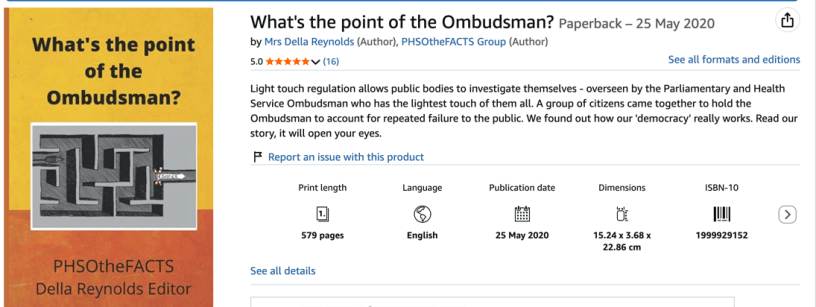
In 2020, PHSOtheFACTS released a book called ‘What’s the point of the Ombudsman?’ We had heard this question so many times from people who approached us, as Ombudsman watchers, since 2013. People were confused and distressed at the treatment they had received. They could not understand how their evidence had been distorted, dismissed or just ignored. At that time, we had a pretty good idea that the point of the Ombudsman was to create an appearance of accountability, while the organisation worked hand in glove with the public bodies it was supposed to be holding to account. We have recently seen much the same with the Environment Agency and the privatised water companies. All regulators appear to be similarly captured.
Given that the whole thing is little more than a collective charade, it was interesting to watch the new recruit, Paula Sussex, along with her supporting cast of Rebecca Hilsenrath, CEO, and the PACAC ensemble, hold a scrutiny meeting on March 24th. This was the first PACAC inquiry into the work of the Parliamentary and Health Service Ombudsman for two years. A first for Paula Sussex and a first for the newly formed committee. But for us, it was our third (and a bit) Ombudsman and the format was all too predictable. First, the new recruit sets ambitious goals, with promises of future improvement, given time, plenty of time and of course, resources. Ms Sussex (or someone on her behalf) submitted a written statement to PACAC ahead of the scrutiny session and at 1.3, we can see the latest trio of expectations.
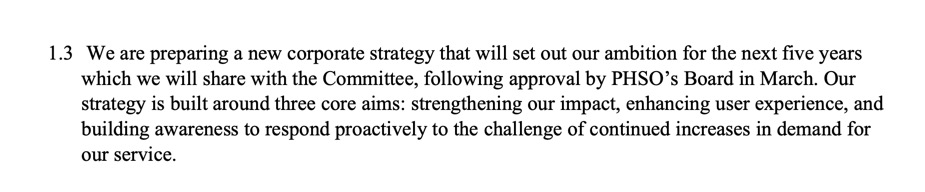
It must have been tricky coming up with these goals after her predecessor, Rob Behrens, had already delivered an ‘exemplary ombudsman’.

But, no matter, management speak is an endlessly malleable entity, particularly when nobody understands what it means. So, let us break down these three new goals
- Strengthening our impact.
Hmmm, at first glance, you may think this means more investigations, more upholds, more action plans and more sanctions for maladministration. But then you have clearly forgotten that the Ombudsman is only pretending to hold public bodies to account, so that would never do. As we will see when we explore further.
- Enhancing user experience.
There is more than one ‘user’ when it comes to the role of the Ombudsman. There are members of the public who have suffered an injustice and have sufficiently survived the internal investigation process to submit evidence to the Parliamentary and Health Service Ombudsman. But the Ombudsman is not called the ‘Servant of the House’ for nothing and with regular face-to-face meetings with the Cabinet Office, the Ombudsman can be in no doubt as to the wishes of the government of the day. When these objectives clash, then we know from the bible the likely outcome.
The King James Version (KJV) reads:
“No man can serve two masters: for either he will hate the one, and love the other; or else he will hold to the one, and despise the other.”
- Building awareness to respond proactively to the challenge of continued increases in demand for our service.
What does this mean? Presumably, the target is reached once full awareness is achieved, regardless of whether or not there has been a proactive response. What is a proactive response? Responding to complaints that haven’t yet been submitted? Do not concern yourself. All will become clear.
It turns out that the way to manage the high demand is to dismiss more complaints by tweaking the ‘public value model’ (PVM). Initiated in 2023, it was the brainchild of the previous Ombudsman, Rob Behrens. A way to cope with the post-COVID rush, initially on a temporary basis.
In response to Charlotte Cane MP, (Q27), Rebecca Hilsenrath gave the following explanation:
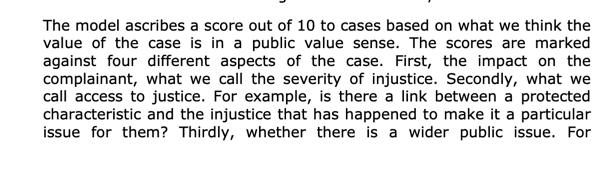
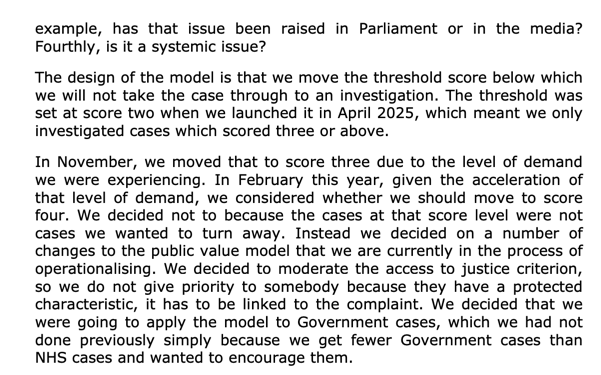
Let me clarify, as best I can. PHSO ascribe a score to each complaint using fairly opaque criteria. If your case fails to score above their arbitrary line, then it is dismissed on the basis that it does not offer ‘public value’. As we can see, the threshold can simply move up to accommodate rising demand and perhaps this is what was meant by a ‘proactive response’.
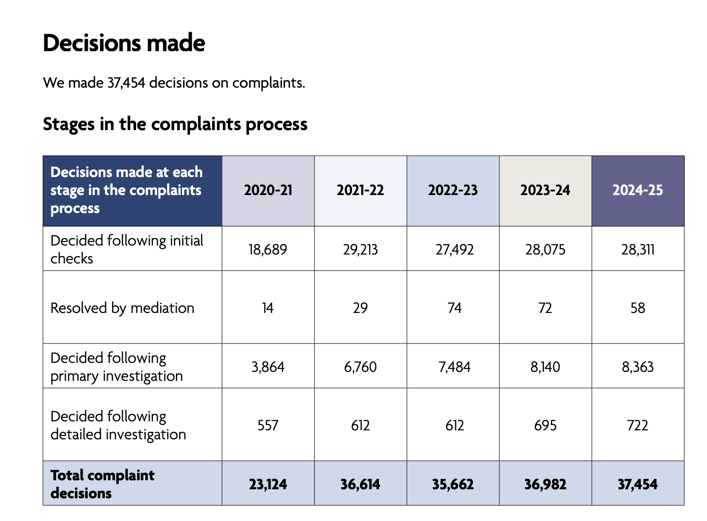
It’s not as though the Ombudsman fully investigates a huge number of complaints in the first place. From page 35 of the 2024/25 annual report, we can see that just 722 complaints received a detailed investigation in 2024/25. That’s 1.9% of all the complaints made. Only a ‘detailed’ investigation can lead to an upheld decision, so 98% of complainants already go away empty-handed. When defending against an accusation of bias, Paula Sussex states that PHSO uphold 60% of complaints, but forgets to add that’s 60% of the mere 2% that receive a detailed investigation.
You would imagine that an avoidable death whilst in NHS care would meet the standard for investigation, but according to the evidence submitted by Andrew Rice to the PACAC committee, this was not the case.
2.1 My son died in state detention. The Trust admitted in writing that they increased his clozapine medication the day after diagnosing him with a respiratory infection—directly contrary to MHRA safety guidance published in August 2020. The internal investigation took nine months (the Serious Incident Framework requires 60 days) and was conducted by Trust employees with no external oversight.2.2 The PHSO declined to investigate. Their reason, stated in their letter of 23 February 2026, was: “the level of injustice did not meet our threshold.”
2.3 A death in state detention, with admitted breach of national safety guidance and a nine-month delay in investigation, did not meet the PHSO’s threshold.
On reading the evidence provided by the father of Jack Rice, who died aged 29, it can be seen that the PHSO caseworker focused exclusively on the delay in producing the serious incident report, stating that had it been over a year, it may have been considered for investigation. Completely overlooking the avoidable death due to the administration of unsafe levels of medication. Easily done.
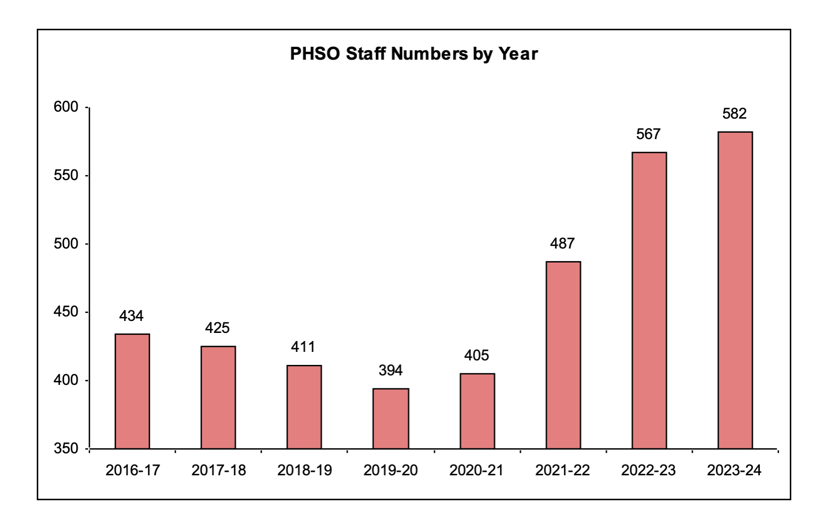
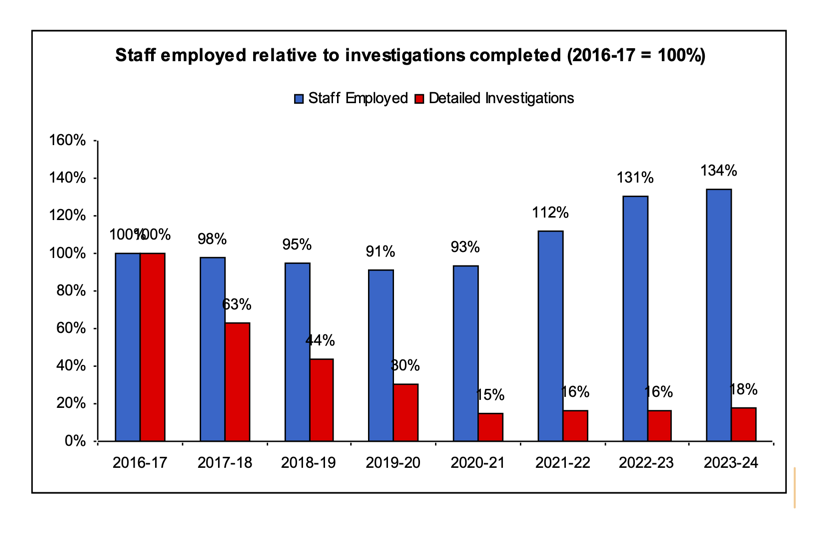
At the scrutiny meeting, there was much wringing of hands over ‘wanting to do more’, yet PHSO currently employs more staff than at any time in the last decade. On page 92 of the 2024/25 annual report, the staffing levels were given as 553.
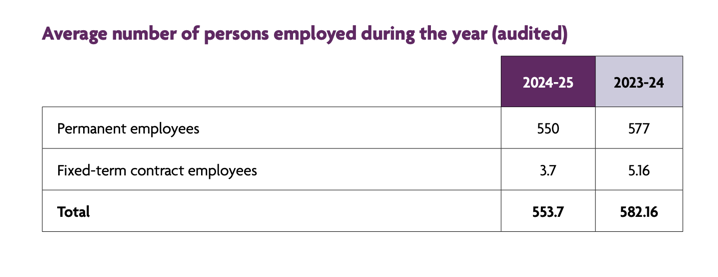
Then, in the 2025/26 strategy, 80 more caseworkers were recruited, bringing the total to 633. From the tables on our home page it can be seen that far more investigations were carried out by far fewer staff back in 2016, when Ombudsman Dame Jule Mellor heralded the ‘more impact for more people’ campaign.
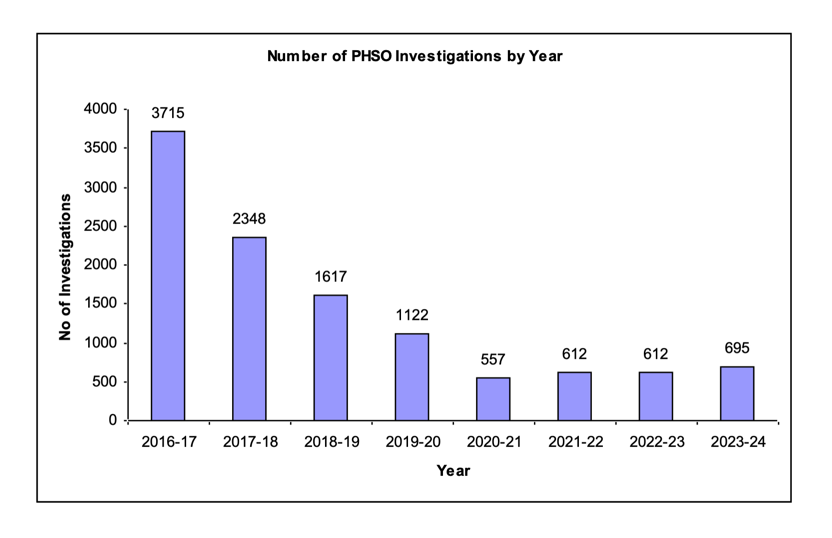
From the ratio chart below, we can see a clear decline in the number of investigations undertaken once Rob Behrens took office in April 2017. Just how this approach enhances the user’s experience is difficult to determine.
From comments made by CEO Rebecca Hilsenrath, it would seem that the staff spend most of their time defending their decision not to investigate or not to uphold. Hilsenrath complained that AI was providing the public with ‘irrelevant’ legislation or jurisdiction, which chewed up staff time.
You can watch the whole of the PACAC scrutiny session here if you feel inclined. Below is a little snippet that might take people by surprise if they have ever tried to contact senior management or, indeed, the Ombudsman directly. Most will have been met with a cease and desist order in line with the PHSO unacceptable behaviour policy. Well, given this very public statement by the Ombudsman that her inbox is open, perhaps they should try again.
In case you feel that I have been too cynical about the real purpose of the Ombudsman, take a look at what this PHSO whistleblower had to say about the organisation in our previous blog.
As the Ombudsman show rattles along for another 5-year plan to nowhere, let us consider the words of Aleksandr Solzhenitsyn,
“We know that they are lying, they know that they are lying, they even know that we know they are lying, we also know that they know we know they are lying too, they of course know that we certainly know they know we know they are lying too as well, but they are still lying. In our country, the lie has become not just moral category, but the pillar industry of this country.”


Looks like the show is to get a new name, according to the latest victim of the PHSO to leave a review on Trustpilot.
It is to become the PSO. Some bad news: ‘The service we provide will remain the same.’
https://uk.trustpilot.com/reviews/6a109094c2860e328f3eece0
LikeLike
They should have called it the public bodies ombudsman as they are the real clients.
LikeLike
Yes, it’s the public bodies that benefit, and service users who lose.
Another example of an ‘independent’ body giving the answer that someone wants:
https://www.gbnews.com/royal/andrew-mountbatten-windsor-trade-envoy-assessment-perks
LikeLike
The show goes on…and more and more Trustpilot reviewers tell us what a con it is:
https://uk.trustpilot.com/review/www.ombudsman.org.uk
LikeLike
They just don’t care. Keep spinning the lie even though many of us know the truth.
LikeLike
Thank you for your comments on the PHSO/PACAC annual meeting. (Thanks to all who went to listen.) II appreciate the clip showing who is now at the helm . You note that the format is all too ‘predictable’ and it does seem an exaggeration to call this process, ‘scrutiny’.
I feel disquiet about the many cases swiped off the desk because they failed to reach the injustice bar. Had complainants known of this cut off, they could have judged whether it was a waste of their time and energy even applying to the PHSO. I understand it is a bar which can move up and down a scale at whim. To ‘encourage’ gov cases the bar is then lowered (?!).
I marvel that the perceived injustice can be determined without proper investigation.
Your insight into this organization is second to none and many appreciate your persistence in trying to hold to account over the years.
LikeLike
Well done Della, I don’t know how you find the strength! I’ve recently had another birthday…83! How did that happen???? I’m not sure how far behind me you are! All this is very draining…. Best wishes Brenda
LikeLike
It is indeed. Nothing but ground hog day again and again!
LikeLike
The PSHO are yet another quango that enables a vile culture of zero accountability within our Public Services. My dealings with them were initially positive as they fully upheld the concerns raised in connection to the sudden death of my son in Dec 2022; a rare Public Interest report was published in March 2025 which generated mainstream media interest. Since then some extremely concerning new evidence has come to light, I took to the PHSO suggesting my son’s case be reopened but they have refused to do so. The facts confirmed that the Health Trust concerned had introduced a new protocol without implementing any risk assesment nor safeguarding measures to monitor the impact – the result was unmanageable system pressure which led to a Critical Incident declaration 3 weeks later. My son may well have received the vital & timely 999 response that was denied to him, had the system not been overloaded resulting in multiple errors. Every which way I have turned to highlight the level of incompetence, indifference & cruelty piled on to bereaved families/harmed patients has been thwarted. There is no authentic or genuine intent to ‘learn lessons’ or ‘make changes to improve patient experience’; but a culture of protecting already blemished reputations & preserving the multitude of duplicated bureaucratic roles within the health sector is alive & well & thriving….
LikeLike
Unfortunately they all collude to cover up harm. As you say there is no attempt to learn lessons. I’m sorry for your loss.
LikeLike
Not being allowed to like, a familiar problem.
Applied for as FOI, PHSO internal case files for my complaint about the Manchester Royal Eye Hospital/ Manchester University Hospitals NHS Trust demonstrated the hand in glove complicity immediately, with a caseworker’s first question to an NHS trust respondent.
The caseworker’s response effectively ruled my complaint out of remit at once. A new registrar’s release of a (deceased) patient’s NHS data also ruled out any investigation by the Trust, on the grounds that the registrar had been working in a private capacity, with a third party. There had been no compliance with secondary employment or data access protocols., and, evidently, a third party had not understood medical information provided to them. My observations on this aspect of my complaint were published last month by the PACAC.
LikeLike
If they’re effectively marking their own homework, then yes, everything must be fine in their world. Reassuring indeed.
In my own case, I submitted a complaint about Derbyshire NHS Foundation Trust. Based on their own independent clinical advice, it was going to be upheld. However, once the Trust was informed, the Trust’s CEO (Steve Trenchard) and the PHSO’s Managing Director (Mick Matin, who was previously a director at the same Trust) colluded to cover it up. The original report that upheld my complaint was destroyed and replaced with a new one that simply copied and pasted the Trust’s version, in clear breach of NICE guidelines and even their own clinical advice: https://patientcomplaintdhcftdotcom.wordpress.com/
This is exactly the kind of “hand in glove” operation the post describes. Welcome to the grubby, corrupt reality of the UK’s so-called accountability system.
Thank you for continuing to expose the show for what it is.
LikeLike
Hi Della. May I have permission to use some or all of your material here under the title And the show goes on’? at my blog at http://www.fourandtwentydeadcrows.com and in correspondence with Basingstoke MP, Luke Murphy? I will, of course, credit you and ‘phsothetruestory’.
LikeLike
Absolutely. Go ahead and spread the word.
LikeLike
It will be great if people in every constituency in England sends a copy of this blog to their MP, particularly those who have MP’s sitting on the Public Administration and Constitutional Affairs Committee (PACAC).
A great piece of work Della. Well done
LikeLike
Regretably, in my case, I don’t think this would be helpful, and might have the opposite effect.
Up to June last year, my MP had been supportive. Referring to the repeated obstacles I’d encountered, including a warning about ‘vexatious’ communication, *he’d offered to act on my behalf, questioning the apparent failure of the police to recognise that the data released to them confirms blindness. I accepted this offer. However, since then, no emails to my MP have been acknowledged, nor was there any acknowledgement of a print letter sent to the constituency office.
* CEO of the Trust had acknowledged the correct meaning of data released to the police, confirming a patient to be severely sight impaired/blind. .
LikeLike