
As the staff at PHSO await their new Ombudsman, the staff survey reveals that treading water has had a negative impact on staff morale.
A blog post by Nicholas Wheatley, PHSOtheFACTS.
The PHSO Staff Survey taken in November 2024 is now available on the PHSO website and it makes for dismal reading for the senior management of the organisation, specifically Rebecca Hilsenrath, the Acting Ombudsman at the time, and the temporary CEO Gill Kilpatrick.
The summary on page 3 of the survey, shown below, demonstrates that none of the scores have improved while many have declined by large margins. Tellingly, the largest declines relate to the Acting Ombudsman and CEO themselves. The staff do not believe that the Acting Ombudsman and CEO had a clear vision for the future of the PHSO, that their actions were consistent with the PHSO’s values, or even that they were sufficiently visible compared with the Behrens era.

The comparison with the Civil Service People Survey (CSPS) on page 7 of the survey, shown below, is equally revealing. Clearly, the staff are happier than the average civil servant with their managers and the feedback they receive from them. However, they are far less happy with the work environment than the average civil servant. Only 22% feel that change is managed well at the PHSO and only 38% feel it is safe to challenge the way things are done, considerably lower than the scores for the same questions in the CSPS. The staff are also clearly unhappy with their career opportunities with only 33% feeling there are opportunities for them to develop their careers at the PHSO and only 40% feeling that the learning and development activities they have completed at the PHSO will help them develop their careers, again much lower than the CSPS scores.

Further results in the survey show there is an increase in the number of claims of staff being discriminated against (10% of respondents) and claims of bullying and harassment (8% of respondents) by both colleagues and senior members of staff.
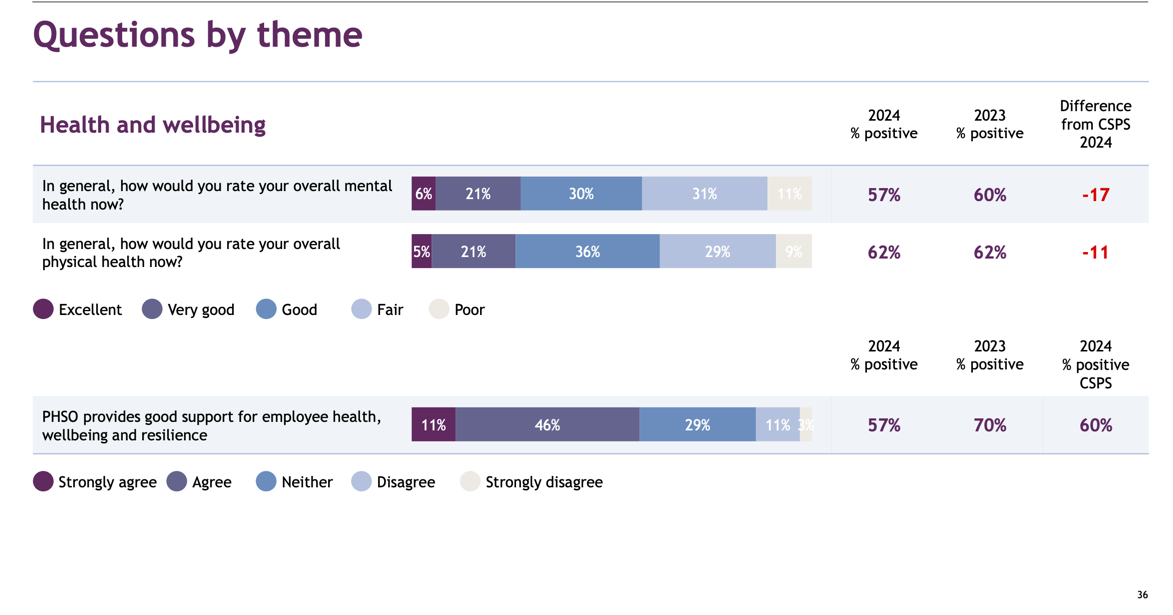
Perhaps of most concern is the low level of mental and physical health reported in the survey. Only 57% of staff at the PHSO felt positively about their mental health compared with 74% of staff surveyed in the Civil Service People Survey. Similarly, only 62% were positive about their physical health compared with 73% in the CSPS. It must be of concern that a member of the public contacting the PHSO regarding a complaint has a good chance of interacting with a member of staff who feels negatively about their own mental health.
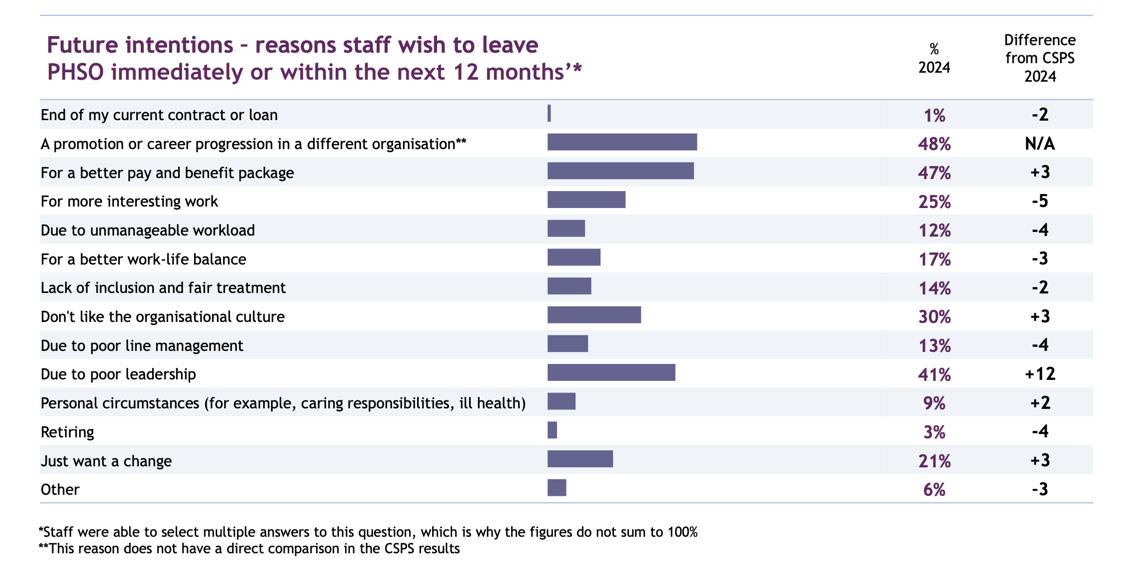
Finally, page 39 of the survey reveals that 23% of PHSO staff want to leave the PHSO as soon as possible or within the next 12 months. Of these 41% said that their decision was entirely or partly due to poor leadership at the PHSO.
The PHSO Staff Survey shows that staff in November 2024 were happy with their managers and team but dissatisfied with leadership and career opportunities. No doubt this is partly down to the disruption of the past 12 months after Rob Behrens left the organisation after 7 years in post and the Prime Minister, controversially and against protocol and precedent, vetoed his highly qualified successor, Nick Hardwick, chosen by Parliament.
The general election and the delay in setting up the new Select Committees meant that it was not possible to appoint a new Ombudsman, and the organisation was forced to operate for 12 months with an Acting Ombudsman. The level of staff dissatisfaction revealed by the survey is clearly something that the new Ombudsman, Paula Sussex, will have to address when she finally takes up her post.
 phsothetruestory
Many thanks to you Nicholas for the update on the working environment and attitude at the PHSO.
If only the Parliamentary Health Service Ombudsman would conduct a factually correct survey on the suffering done to victims who attempted to best engage this dodgy Ombudsman site.
LikeLike
‘My manager motivates me to be more effective in my job’ – 84%.
The ones who consider complaints valid probably aren’t still around to answer the question.
438 reviews on Trustpilot now. Still a ‘bad’ rating:
https://uk.trustpilot.com/review/www.ombudsman.org.uk
LikeLike
What does more effective mean? Mmmm
LikeLike
You raise an interesting point the public may well be contacting a member of PHSO staff who has mental health issues and a lack of faith in their own leadership.
We can expect the Ombudsman’s 2024-25 annual report sometime in July if precedent is followed. It will be interesting to pull out the staff turnover rate and compare it with the Civil Service norm
LikeLike
First, great work on the staff survey Nicholas. Unfortunately both public and private bodies spin these things and ignore the inconvenient findings. They get the best of both worlds – “aren’t we sensitive and transparent?” and “sorry, nothing will actually change”.
Your hypothesis is quite valid David. My 2020 complaint took a year to be allocated. The “Senior Caseworker” took a further year to produce her report. She seemed to be off sick quite a lot. Then, although I had named Hilsenrath in the complaint (re her time at the EHRC) there was no mention of her whatsoever in the final adjudication. The SCW just said, “it’s all fine”. By that time Hilsenrath had worked for the PHSO for 18 months in a senior role, having got it, as we think, because she was a favourite of Behrens.
The caseworker then lied to me about the status of my resulting review request, causing yet further delay. By the time a (very competent) reviewer found, with no apparent difficulty, that the adjudication was completely untenable, Hilsenrath was CEO.
So there is circumstantial evidence that this particular SCW was so reluctant to criticise Hilsenrath that she deliberately produced a deeply flawed adjudication and then sabotaged the review process.
No such thing has been admitted, of course, and I don’t know whether any action has been taken against the SCW. In all likelihood she’s been promoted for her loyalty to Hilsenrath…
The new caseworker had little to do until the Welsh Ombudsman found Hilsenrath guilty of maladministration, but then acted with unseemly haste in shutting down the investigation on the ground of the passage of time since the original complaint – delay which had been caused entirely by the PHSO itself. She seems competent enough but she too seems to be under the control of Hilsenrath and other senior staff, simply channelling unreasonable decisions to me, presumably handed down to her by Governance and Legal.
Seriously, it is concerning.
I also found, of course, that “Governance” and Legal staff were so similarly in thrall to Hilsenrath, apparently, that they too have produced a string of decisions and responses that seem completely irrational and absurd, usually ending “if you are not happy you can make a claim for Judicial Review…”
Aside from my continuing efforts to get a reasonable response from the PHSO, I have recently complained to the Solicitors Regulatory Authority about a breach of the Code of Conduct by PHSO lawyer Jack Boyle. He deliberately flouted the duty of candour in Judicial Review and then claimed that the FOIA and the DPA are acceptable substitutes for compliance. But he too is rather junior and I suspect he is only following instructions from higher up.
Needless to say, the Information Team has failed to comply with its obligations under the FOIA and the DPA, and so it goes on!
If only the PACAC would take an interest, but plainly it will not.
LikeLike