

Private Eye has been running a series of articles exposing the disingenuous way that the Parliamentary and Health Service Ombudsman (PHSO) handles complaints. The first was in issue 1641 on 24 Jan – 6 Feb 2025.
When describing their experiences with the ombudsman to Private Eye, Naomi and other complainants spoke of a combative response, inexplicable delays, poor communication, an unmanageable burden of proof, endless emails and, ultimately, the NHS body’s word carrying far more weight than theirs.
In response to this criticism, a PHSO spokesperson simply sidestepped the damning accusations and spun a few numbers to make it look like the organisation was doing a better job than it actually was.
A PHSO spokesperson said: “Demand for our service has increased substantially in recent years and we have helped thousands of people get justice. Between April 2020 and March 2024, we saw a 48 percent rise in the number of cases accepted for consideration.”
Firstly, ‘accepted for consideration’ does not mean ‘given a full investigation’. It simply means that the complaint was not rejected within the first week. The choice of dates aptly demonstrates the way organisations such as PHSO use data to spin a more positive story. During the Covid period from 26 March 2020 until 1 July 2020, the PHSO stopped processing complaints leading to an artificially low number of cases accepted for consideration in that financial year. Using April 2020 as the baseline allowed them to make the (artificially) high 48 percent increase claim.
Following this article, many more people came forward with their stories to Private Eye. In Issue 1462 – PHSO says no, Private Eye exposed the devious ways PHSO avoids investigating valid complaints.
Carlier told the Eye: “Their stock response seems to be, the answer’s no, what’s the question?”
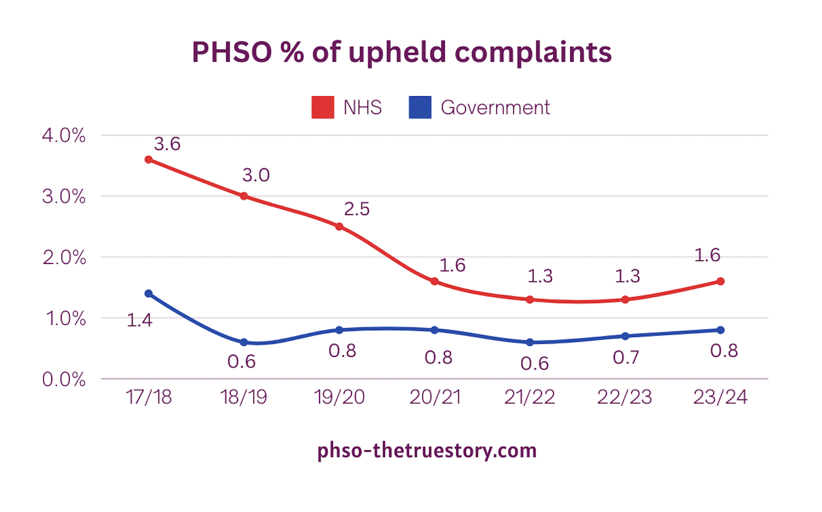
The article states that only 115 complaints were fully upheld last year – a mere 0.3 percent of the 37,000 submitted. With such a low uphold rate, many dissatisfied people are keen to tell their stories to anyone who will listen.
The Eye has been flooded with similar stories from users who say the overwhelmed PHSO seems keener to bat away grievances rather than resolve them or ensure lessons are learned.
In 2014, under CEO Katherine Murphy, The Patients Association released the first of three reports into the failings of the Health Service Ombudsman. The following quote is from the introduction to their second report released in 2015.

When Rachel Power took over in 2017, all three reports were removed from the Patients Association website but can still be seen here. It is clear from the recent Private Eye exposure that nothing has changed at PHSO. In fact, things are likely to be much worse as the uphold rate has declined since 2017.
Time then for a full, government-backed inquiry into the ability of the Health Service Ombudsman to improve patient safety by holding bodies to account and recommending appropriate action plans so that lessons are learned. Step in Dr Penny Dash with her proposed patient safety investigation.
This review will:
- map the broad range of organisations that impact on quality (and therefore have links to safety), but will not examine them in detail
- focus on 6 key organisations overseen by the Department of Health and Social Care, which have a significant impact on safety
Unfortunately, we have learnt that the 6 key organisations do not include the work of the Ombudsman. Of course, should the inquiry find that any or all of the 6 key organisations are failing to deliver on patient safety this would, by default, be critical of the Ombudsman who has the job of holding these bodies to account.
In 2023/24 it can be seen that the Department of Health and Social Care had 19 complaints made against them with zero receiving a full investigation. If we include complaints made against the Care Quality Commission (CQC) in 2023/24, CQC being one of the 6 key organisations, we see a similar story. 58 complaints received, 3 given a detailed investigation with just 1 partial uphold to date. If this data were relied upon, there would be no need for an expensive enquiry but Dr Penny Dash has already found the Care Quality Commission to be a failing organisation.
The Dash review finds significant failings in the CQC, which it says ’has lost credibility in the health and social care sectors’. It finds that the CQC’s ability to identify poor performance and support quality improvement has deteriorated. The review says this has undermined the health and social care sector’s capacity and capability to improve care.
It would appear that the CQC is not the only body that has difficulty identifying poor performance but without inclusion in the review, PHSO will manage, once again, to escape accountability. Just like Macavity, the Napoleon of Crime!
Macavity, Macavity, there’s no one like Macavity,
There never was a Cat of such deceitfulness and suavity.
He always has an alibi, and one or two to spare:
At whatever time the deed took place—MACAVITY WASN’T THERE!
And they say that all the Cats whose wicked deeds are widely known
(I might mention Mungojerrie, I might mention Griddlebone)
Are nothing more than agents for the Cat who all the time
Just controls their operations: the Napoleon of Crime!
T.S. Eliot
 phsothetruestory
Regarding PHSO investigations into complaints about HMCTS : FOI data they provided (18.03.25) shows that, out of 1356 HMCTS complaints from Jan ’22 to Dec ’23, 7 had detailed investigation just one was partially upheld—just 0.079%
LikeLike
Parliamentary and Health Service Ombudsman Supplementary Estimate Memorandum for 2024-25
pub. 25/2/25
‘Objective 1: People who use public services have a better awareness of the role of the Ombudsman and can easily access our service
£14.312m
Objective 2: People we work with receive a high quality, empathetic and timely service, according to international Ombudsman principles
£15.788m
Objective 3: We contribute to a culture of learning and continuous improvement, leading to high standards in public service
£9.853m
…
We are also focussed on driving improvements in the standards of complaint handling within the NHS and Government departments.’
https://committees.parliament.uk/publications/46732/documents/240677/default/
LikeLike
With PHSO it’s the same targets every time. They won’t achieve them and simply rinse and repeat. And no one in authority ever seems to notice.
LikeLike
Maybe PHSO employs people in authority who have been spun out of quangos and the like. When MPs lose their seats, where do their staff go?
LikeLike
Quangos and think tanks are retirement homes for civil servants.
LikeLike
As is well known, the current Ombudsman Hilsenrath got a cushy job at the PHSO when she was (probably) about to be sacked as CEO of the EHRC. So there’s a good example for you!
LikeLike
‘A PHSO spokesperson said: “Demand for our service has increased substantially in recent years…”‘
And so has the number of people voicing their dissatisfaction with the service:
https://uk.trustpilot.com/review/www.ombudsman.org.uk
People ground down over the years, substantial issues not properly addressed, evidence not properly taken into account, missing documents, dismissive phone calls etc.
If Elon Musk was looking into the PHSO it would be shut down tomorrow!
LikeLike
And good job too!
LikeLike
It’s the ‘unimaginable burden of proof’ that rings so true with me. The files I compiled over a period of nearly seven years, all my own work, the investigator didn’t have to lift a finger. It’s only afterwards, and years later, when you realise you gave them every last detail with nothing left out and it’s all they needed to weave their investigation through your evidence to come up with a plausible reason why the NHS Trust did no wrong.
LikeLike
Same here. Was told by Phso solicitor that my evidence was exemplary. They still closed my case with no uphold.
LikeLiked by 1 person
Hi Della,
Outstanding – informative and hard hitting.PHSO defined reason for immediate rejection of my complaint was that a registrar had been ‘ working outside NHS employment ‘ PHSO putting that question to the NHS Trust concerned. My appeal against this decision failed, of course, PA recommended a FOI request for the internal case files. – 96 A4 pages – mostly doubled sided , as they work through non-reasons for not investigating further,
I wonder if the total wasted time, paper and interestingly matey ‘ Hi Angie, you guys etc) , communication for this case is typical ?
Rosamund
Email, because there seem to be problems using my real name – Rosamund Ridley ( which sounds like a pen name) – and not my actual pen name, used for WordPress blog and e-books.
LikeLike
Still get a weekly update on patient safety from the Government it’s usually about various approved drugs although one was about findings from the call of evidence re the statutory duty of candour. Hurrah another report ‘analysing’ the responses.
When the new Government started I wrote to Wes Streeting quoting him from the article from The Guardian which states that anyone bullying whistleblowers will never work for the NHS again. Said I would be grateful for updates. Copied in to Rachel Reeves keen to save money. Mentioned I was sent for an unnecessary ultrasound to keep my particular cover up covered.
Also said with all the arsenal of so-called patient safety schemes paid for by the Government, might not they save money by dealing with the inevitable mishaps instead of covering up. To say nothing of all the public inquiries. No answer from either. Surprise.
I have subscribed to a UK Parliament newsletter one of which was procrastinating about ‘special inquiries’ as the House of Lords appoints special inquiry committees every year including improving the public inquiries process:-)
Love the poem.
LikeLike
Its all process and no action.
LikeLike
Private Eye has been doing sterling work playing a part in exposing this long standing and ongoing saga. However, they cannot do it alone which is why everyone affected MUST play a part in exposing this shameful organisation, correctly identified as ‘a swiz’ by Quintin Hogg when it was set up in 1967 perpetrated on patients and their loved ones.
There is, of course, no appetite amongst politicians for instigating change, particularly when the Prime Minister stood at the Despatch Box in the House of Commons on 18th December 2024 to dismiss the recommendations of a six year investigation by PHSO which culminated in findings of failure at the DWP by simply saying ‘the country can’t afford it’.
Insofar as the nations health is concerned, it really is the wide west now. Integrated Care Boards given absolute power as to who qualifies (and gets) funding for treatment by a plethora of private companies contracted to deliver services.
There were occasions in the Wild West when the sheriff got shot. We can but hope Parliament puts R.I.P on the PHSO headstone and replaces the organisation with something that properly holds the NHS and Government Departments to account
LikeLike