

As the new (interim) Ombudsman settles her feet under the table let us look at the absurdity of the handover protocol. From the 2023/24 Annual Report, new (interim) Ombudsman Rebecca Hilsenrath and new (interim) CEO Gill Kilpatrick have set out their stall.
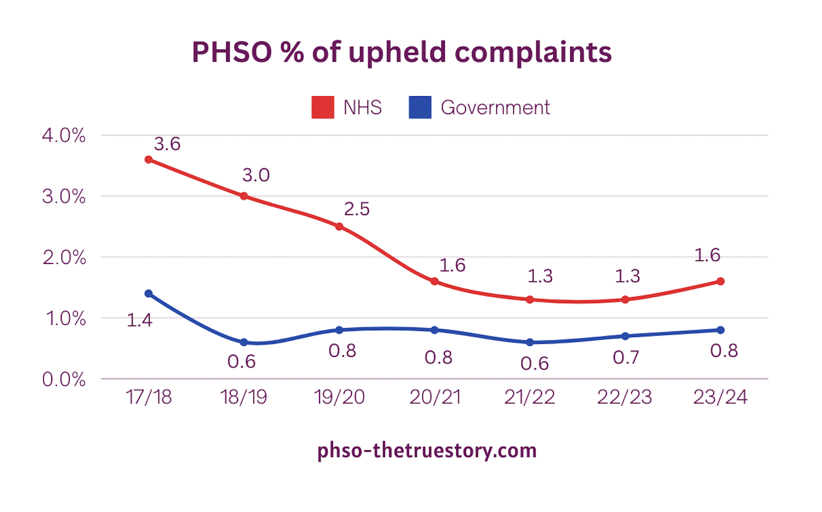
To help you put their statements into context it would be useful to bear in mind the extremely low uphold rate. Less than a 1% chance of having a government complaint upheld (this includes partial upholds) and less than a 2% chance for complaints about the NHS.
Step 1. Praise your predecessor for their legacy.
We said farewell to our long-standing Ombudsman and our Chief Executive Officer, Sir Rob Behrens and Amanda Amroliwala. Given the extraordinary foundations they laid together, I was deeply honoured to be appointed to succeed Amanda as Chief Executive Officer and to support Sir Rob in his final year here. p8
Step 2. It’s all about you.
Our work is driven by a belief in the power of complaints. Complaints provide the opportunity to learn and to strengthen relationships between people and public services. As part of this, we seek impact in two ways – on the lives of individuals and in terms of improving public services. page 8
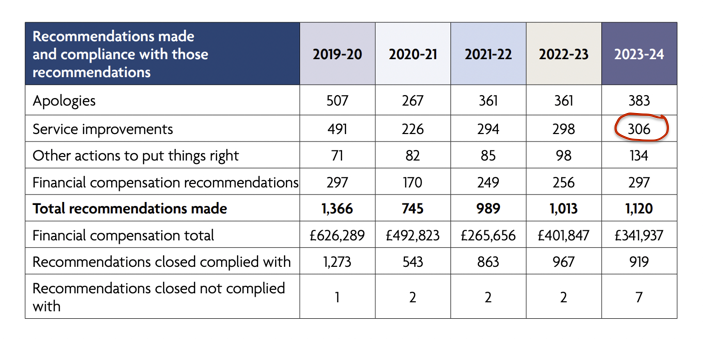
Well, the data tells us that barely 3% of the lives of individuals are impacted by a positive uphold, resulting in 97% of those who have taken the trouble to complain to the Ombudsman feeling let down once again. What of the impact on improving public services? The table below shows just 306 service improvements recommended from all the many thousands of NHS and Parliamentary complaints. There is no guarantee that any of these service improvements have actually been implemented as PHSO does not physically check follow-through and neither does the CQC.
Step 3. Makes changes to the processes the praised predecessor put in place.
This quote from CEO Gill Kilpatrick – page 10
This year we have made great progress in our modernisation programme. Our casework is at the core of what we do and we recognise the need to change our approach to meet the demands on our service. Throughout the year we developed plans for a new approach, based on value to the public.
Based on ‘value to the public’ is an ambiguous statement. Given that PHSO sucks up over £40 million of public money for very little return, it could be argued that the best value to the public would be to scrap the service altogether saving not just the money but the emotional roller-coaster of raised expectations. We will have to wait and see just what this new policy amounts to.
Step 4. Change the way satisfaction is measured.
An independent company helps us to collect feedback from our service users throughout the
year. In response to a recommendation from PACAC, this year we revised our Complainant and
Organisations We Investigate (OWI) surveys. This is to help us better measure the impact of changes to the service we provide and capture complaint outcomes. p48
Essentially, the previous ‘Service Charter’ which consisted of 16 measured criteria has been reduced to 7 statements to which those surveyed can either agree or disagree.
In 2023 to 2024, a total of 5,687 complainants completed the survey. Of those complainants, more than half felt that caseworkers gave them the opportunity to explain their complaint (69%), took the information they provided into account (57%), acted with sensitivity to the issues raised (65%), and explained the guidelines (67%) and information used in making their decision (59%). Less than half of respondents were satisfied with the overall time taken to reach a decision (44%) and the service received overall (48%). p48
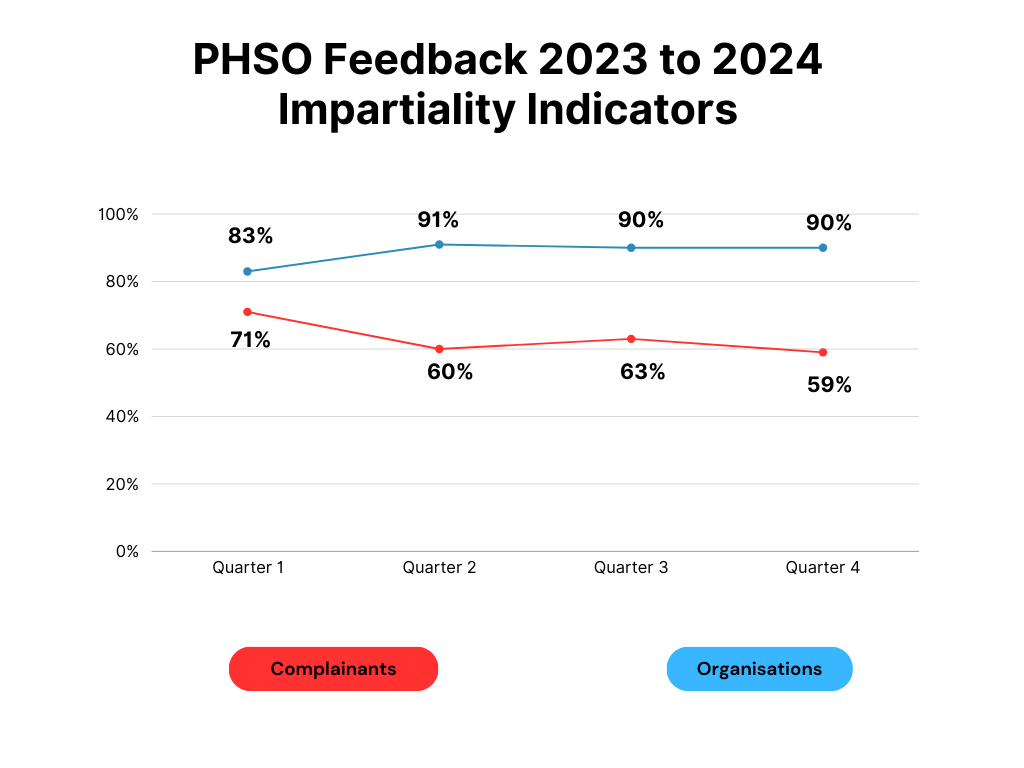
The same survey questions are given to both complainants and organisations investigated. Some mathematical algorithm is then applied to the responses to give an ‘impartiality indicator’. PHSO has always been reluctant to ask outright whether those who use the service found it to be impartial. If the Ombudsman treats both sides equally then the scores on the impartiality indicator should coincide. However, the organisations consistently score higher than the complainants and in the last measure taken (January to March 2024) were over 30% adrift. This fact was omited from the Annual Report but the data is available on their website.
Step 5. Praise your staff – bringing them on board for more changes to their work routines.
I thank the Board for their constant support, advice and encouragement and, most of all, the community of colleagues at PHSO who constantly move and impress both me and complainants with the professionalism and compassion they employ to bring understanding and resolution where services and relationships have failed. I am so proud to be your Ombudsman. Rebecca Hilsenrath Accounting Officer, Acting Ombudsman and Chair p9
As with other public sector organisations, we cannot stand still. One of the key things I have learned is that the only way to improve is by having great people. By working together, we can achieve great things. Gill Kilpatrick Acting Chief Executive Officer p11
There are various identifiable elements to this handover process. The first is that you must praise your predecessor (unless they have resigned in disgrace) and thank them for all the invaluable work and progress made. The second is that you go on to redefine key principles and operating structures essentially unwinding any progress made. You change the way success is measured making sure that no direct comparisons can be made. Then having set the organisation on a new path toward the ever-elusive goal of ‘improvement’ you effusively praise your staff team bringing them on board for another radical make-over of their working practices. Organisations, such as this, are on a continual journey of self-improvement which they maintain by regularly going round in circles. And so the show goes on ……
 phsothetruestory
The back-story to this PHSO propaganda
“In 2023 to 2024, a total of 5,687 complainants completed the survey. Of those complainants, more than half felt that caseworkers gave them the opportunity to explain their complaint (69%), took the information they provided into account (57%), acted with sensitivity to the issues raised (65%), and explained the guidelines (67%) and information used in making their decision (59%). Less than half of respondents were satisfied with the overall time taken to reach a decision (44%) and the service received overall (48%). p48“;
is the exhausting mountain victims had to climb before they even reached the summit of the PHSO.
Its interesting that neither the enquiry into the Infected Blood Scandal or the Post Office/Horizon/IT Scandal refer to the failure of the “regulators” to ignore the victim’s complaints prior to the scandal catching the attention of Parliament.
All of my FOI’s on “How Many Of The Victims Had Previously Taken Their Case To An Ombudsman” to both Inquiries were bounced back unanswered because – these Public Inquiries are not beholden to respond to Freedom Of Information requests!
LikeLike
PHSO first published Principles of Good Complaint Handling in 2009 (see their website for details). If the NHS and Government Departments were taking any notice, then PHSO in theory, should see a substantial fall in approaches to them by the public.
So how is it going? From page 15 of the latest annual report they state:
8,835 complaints decided following primary or detailed investigation (9% increase on previous year, highest annual volume on record)
36,982 complaint decisions made in total (highest on record)
Hardly demonstrates their ‘light touch’ approach as a roaring success does it?
LikeLiked by 1 person
It would also appear that their much lauded ‘standards’ are also not working. It’s all a distraction. Giving them something to do while they are not investigating complaints.
LikeLiked by 1 person
Regarding the financial compensation tota.l.
My understanding is that the compensation figure is made up of (i) a payment for poor complaint handling and (ii) arrears due.
The Ombudsman could recommend that a person, say, wrongly deprived of of money from the DWP gets £100 for poor complaint handling plus the amount they have been deprived of.
This case concerning a farmer illustrates the point.
The case study heading:
‘Over £40,000 payment to farmer after incorrect advice‘.
The final paragraph:
‘Putting it right
As a result we asked RPA to apologise to Mr J, pay him £1,000 for its poor complaint handling and pay him his single payment scheme entitlement for 2011 plus interest.’
https://www.ombudsman.org.uk/about-us/our-casework/how-our-casework-makes-difference/case-summaries/262
Something said by a senior member of PHSO staff that raises concern on the reliability of PHSO stats:
‘Do you remember the names of the individuals from last night who said that they had a positive experience of PHSO? I am keen to ensure that we keep their details as further down the line PHSO may want to ask them if they would like to be involved in another activity going forward.’ (p.65)
(comment dated 25 May 2023)
https://www.whatdotheyknow.com/request/positive_feedback_received_from#incoming-2076979
LikeLiked by 1 person
It’s all smoke and mirrors Jeff
LikeLiked by 1 person
Not ONE political party in any manifesto in 2024 suggested a best review of the PHSO.
In September 2024, Labour in Government states that the NHS is “broken”. Its a real shame that Labour in power champions the poor state of the NHS whilst turning a blind eye to the opportunities that could be gained if the PHSO ensured that there was a “Learning From Experience” report behind every error/mistake/ scandal brought the attention of the Ombudsman.
No wonder the logo for the PHSO is made up of 3 speech circles?!
At each stage of the complaints process – nobody cares enough to best listen and learn.
LikeLike
Three speech circles or 666?
LikeLiked by 1 person
LOL! Missed that reference! Well spotted!
I wonder in which year and which agency designed the PHSO logo?
The graphic design team might have best understood the real remit of the PHSO.
LikeLike
‘Our work is driven by a belief in the power of complaints. Complaints provide the opportunity to learn and to strengthen relationships between people and public services. As part of this, we seek impact in two ways – on the lives of individuals and in terms of improving public services.‘
Ombudsman speak for:
‘Our work is driven by a belief in the power of complaints. Complaints provide the opportunity to earn and to strengthen lengthy and ultimatelty futile relationships between people and public services. As part of this, we seek impact in two ways – on the lives of individuals and in terms of defending the indefensible.‘
LikeLiked by 1 person
Thanks for the translation. It is obviously closer to the truth. I wonder if phso staff actually believe their own rhetoric.
LikeLiked by 1 person
Me thinks that the PHSO employees best know the harm they cause.
The PHSO chap who seemed to collude in the malfeasance that meant that my key evidence and my witness’s evidence was redacted from my case file before the PHSO Panel reviewed it in February 2013, smugly made himself known to me now that he works for the Communications Ombudsman a decade later.
My query to the Communications Ombudsman – as to the reason that the chap who helped to sabotage my casefile with the PHSO was put in charge of my complaint with the Communications Ombudsman has still not been best acknowledged or answered.
LikeLike
Great analysis! The PHSO are full of it, but hide the fact that they actually provide little if any value to the public at all.
It seems that the “extraordinary foundations” laid by Rob and Amanda created an organisation that upheld the smallest number of complaints ever. What a great service for the public!
They certainly have an “impact….on the lives of individuals” though, leaving them emotionally distraught and hollowed out after their decisions.
As for the impartiality indicators, no-one measures impartiality in this way. A dash of explanation, a pinch of sensitivity, a hint of information, and voila – impartiality! Utterly ridiculous, but suits this ridiculous organisation to a tee.
LikeLiked by 1 person
Ditto Mr Wheatley’s feedback.
We can take for granted how time-consuming and mentally exhausting it must be to maintain an overview of the utter rubbish distributed by the PHSO propaganda-PR-machine.
LikeLike
Incisive as always. Comparison, year on year and with changes at the helm, is hobbled with all the switches in operation regarding data. The time and energy directed to figure massaging in order to appear in the best light, could be better used in getting a proper grasp of a complaint in the first instance and remaining completely impartial throughout.
Thank you for breaking this down.
MW
LikeLiked by 1 person
This is really good stuff!
LikeLiked by 1 person
I’m jaded by it all. Can’t you tell.
LikeLiked by 2 people
Its over 2 decades of your life – dealing with the fake news from the PHSO isn’t it? CRIKEY?!
LikeLike