

The role of Parliamentary and Health Service Ombudsman is a prestigious and well-paid appointment and we learn from David Hencke that 52 (no doubt, well-qualified) individuals applied for the recent job vacancy. Unfortunately, none of them were actually appointed and it was necessary for the relatively new CEO, Rebecca Hilsenrath to step in as interim Ombudsman.
Due to Mark Benney’s judicial review challenge regarding this appointment, one or two interesting questions have emerged. Such as, did Prime Minister, Rishi Sunak meddle beyond his powers in the appointment process and was this a deliberate act to allow Hilsenrath into the top job via the back door?
Ex-Government lawyer, Benney, believes the appointment of Hilsenrath as interim (and possibly permanent) Ombudsman is legally flawed, as she failed to disclose that there is an open investigation at PHSO into her actions during her time as CEO at the Equality and Human Rights Commission (EHRC). David Hencke confirms Benney’s primary accusation that BAME and disabled civil servants suffered discrimination due to government policy.*
“When she was chief executive of the Equality and Human Rights Commission, she carried out a campaign to sack black and disabled employees who happened to be strong trade unionists – a remarkable feat for a body that should champion diversity.“
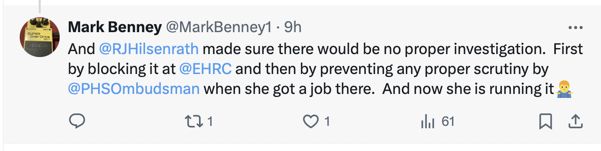
Benney claims that Hilsenrath deliberately scuppered proper investigation into his complaint regarding this matter and shares his concern that his ongoing PHSO case will not receive a fair appraisal now that she has the top job.
Benney brought the actions of the PM into question in his pre-action protocol letter claiming that the PM should not have appointed Hilsenrath as interim Ombudsman while an open complaint about her was ongoing. He also called on the PM to reverse the appointment. The response from the Treasury Solicitor is interesting (emphasis added).
15. First, in relation to your claim against the Office of Prime Minister, there is no relevant reviewable decision. The Office of Prime Minister put forward a recommendation to the House of Commons, which – following the decision by the House to present the Humble Address to His Majesty the King – was thereafter duly accepted by His Majesty the King and given effect by Letters Patent. There was no relevant ‘decision’ reached by the Office of Prime Minister, which did not have the relevant decision-making power.
18. You also contend, under heading 8(i) of your PAP Letter, that Ms Hilsenrath should be suspended by the Prime Minister. As set out above, that is not a step that the Office of Prime Minister has power to take and is not a remedy that could be awarded by the Court.
The rebuttal confirms that decision-making powers lie with the House as the Ombudsman is independent of government.
7. Paragraph 5.40 of The Cabinet Manual explains: “The Parliamentary Commissioner for Administration, known as the Parliamentary Ombudsman, is an officer of the House of Commons appointed by the Crown and is independent of the Government. In recognition of the Ombudsman’s relationship with Parliament, the House now leads on the recruitment to the role.”
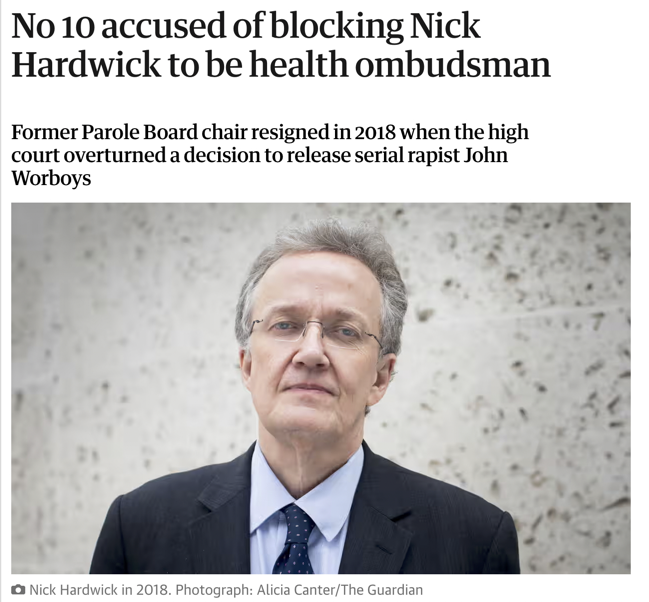
All well and good except that the PM did make a decision. As reported in the Guardian on 27.3.24, he decided to sit on the correspondence from William Wragg, Chair of PACAC which put Nick Harwick, forward as their preferred candidate. Without any explanation, the PM left this correspondence languishing in his in-tray for three months, until it was too late to complete the due process of the House
Was this a deliberate act to leave the way clear for Hilsenrath? She had certainly been a government ally whilst CEO of the EHRC. She refused to open an investigation into Islamophobia in the Conservative Party on the basis that they were due to carry out their own investigation into the matter.
We have given very careful consideration to complaints raised about discrimination and Islamophobia in the Conservative Party. We have concluded, in the light of the decision by the Party to institute an independent investigation, that it would not be proportionate to initiate our own investigation at this stage. We will be monitoring the review and requiring the party to provide regular updates on progress. If we are not satisfied with progress or how the investigation is conducted we will review our decision and do not rule out the use of our legal powers.
Whilst Jeremy Corbyn was leader of the Labour party the EHRC felt it was proportionate to open an investigation into antisemitism within the party even though there had already been two investigations into this matter by Chakrabarti and the Home Affairs Select Committee. In their final report, the EHRC found legal breaches.
Our investigation found that the Labour Party has committed unlawful acts.
We published a report about our findings, including our recommendations for change.
The Labour Party is now legally obliged to draft an action plan to tackle the unlawful act findings we made. This should be based on our recommendations.
Once the action plan is agreed, we will continue to monitor it. If the Labour Party fails to live up to its commitments in the legally binding action plan, then we may take enforcement action.
By the time the report was published in 2020, Corbyn was no longer leader of the party and with the ascension of Keir Starmer media coverage of antisemitism within the party faded into the background. Despite the change in leadership, the EHRC report confirmed that they would take enforcement action against the party should antisemitism continue. By 2023 Jewish Voice for Labour (JVL) took legal action against the party leadership for discrimination towards Jewish members. A letter from their legal team, which was copied to EHRC stated that Jewish members were disproportionally investigated and expelled.
A legal letter to the party from Bindmans LLP on behalf of Jewish Voice for Labour sets out compelling evidence that Jews who disagree with the current leadership about Israel, Palestine, Zionism and antisemitism suffer disproportionately from the Party’s harsh disciplinary regime. Jewish members are 6 times more likely to be investigated and 9.5 times more likely to be expelled from the Labour Party for antisemitism than non-Jewish members.
The letter invites the Party to acknowledge that it: “is in breach of the Equality Act 2010 by discriminating unlawfully against its Jewish members and unlawfully harassing them in (a) the manner in which it investigates complaints made against them and (b) its failure to investigate complaints made by them.”
To date, EHRC has taken no further action against the Labour Party.
It would appear that Hilsenrath is a person who will follow Government orders, even when vulnerable people suffer as a consequence. She is now within spitting distance of taking on the permanent role of Ombudsman; a role which requires her to protect vulnerable citizens from powerful government bodies.
There is a final twist to this tale. William Wragg, Chair of PACAC was concerned that Cabinet Office protocol had not been followed in the appointment process and made this clear in the House during the debate to secure an interim Ombudsman, as recorded in Hansard 25.3.24.
The motion as it appears on the Order Paper is seemingly innocuous, but behind it there is a short story to be told—one that very few are aware of. The saga, if I may call it that, of the appointment of a new Parliamentary and Health Service Ombudsman for England began in the summer of last year. An appointments panel was assembled, of which I was a member. The second permanent secretary at the Department of Health and Social Care, an independent member and the former president of the International Ombudsman Institute were also members, and the panel was ably chaired by Philippa Helme, late of this parish—as many of us will remember, she was a senior Clerk. We went about our business diligently, sifting through an initial 52 applications for the role, longlisting and shortlisting. We then took on a day’s interviewing during which we interviewed four candidates. We judged three of them to be appointable, and put forward a recommended name to the Prime Minister.
I am sure we are all aware, but I shall repeat it to refresh our memory, that “The Cabinet Manual” makes it very clear in paragraph 5.40 that
“The Parliamentary Commissioner for Administration, known as the Parliamentary Ombudsman, is an officer of the House of Commons appointed by the Crown and is independent of the Government. In recognition of the Ombudsman’s relationship with Parliament, the House now leads on the recruitment to the role.”
Unfortunately, the name put forward—I am not going to say that person’s name, so as to protect their privacy at this juncture—has seemingly been declined by No. 10. Given that No. 10 was notified of the name in January and it is now March, some time has elapsed, during which it would surely have been possible to confer that seal of approval.
Clearly, things are now more topical, given last week’s report from the ombudsman on the women’s stage pension age. Maybe that has sharpened the focus, but in winding up the debate—if we can call it that—might my very able hon. Friend the Minister for the constitution, in whose hands the constitution of this country is always safe and sound, be able to elaborate on what has happened? Why is there the need to appoint a temporary ombudsman? I have absolutely no problem at all with Rebecca Hilsenrath, who is the chief executive of the organisation; I am sure she will do a splendid job. None the less, it is somewhat irregular that after a recruitment process lasting several months in which proper procedures have been followed, it seems that No. 10 is not prepared to recognise the recommended name from the recruitment panel. Could my hon. Friend explain?
Unfortunately, the Minister for Constitution did not give an explanation and by the 9th of April Wragg was no longer in a position to pursue the matter having been outed as a ‘sex pest’ in a sting operation.
William Wragg quits Commons roles over Westminster honeytrap.
With the coming election, Sunak is unlikely to face any inquiry into his actions. William Wragg may live to regret questioning those actions, nearly making it out of his parliamentary career with his reputation intact. It will be for a new administration to pick up the appointment of a permanent Ombudsman. Will they follow due process or simply pick up the rubber stamp so conveniently left behind?
*Mark Benney wishes me to make clear that he wasn’t complaining about discrimination within EHRC. He was complaining about indirect discrimination (see the Equality Act 2010) arising under the individual performance management system imposed on all 450,000 civil servants by the Cabinet Office in 2012. He estimates approximately 100,000 BAME and disabled staff were disadvantaged over varying periods of at least four years. Further details here: https://core.ac.uk/reader/187118656
 phsothetruestory
David Czarnetzki
Nothing can be done over the next few days. However, if Kier Starmer becomes Prime Minister on Friday and he is serious about bringing public trust back into politics, he could do no worse than start right here.
Firstly. Suspend the Acting Ombudsman – no ifs no buts.
Secondly. Immediately recommence the appointment process from which the Acting Ombudsman should be excluded.
Thirdly. Stay out of blocking any recommendation the appointment panel makes.
If Kier Starmer does not become PM, we can probably expect little change in the level of integrity.
Finally, there needs to be an inquiry into how this situation came about.
LikeLiked by 1 person
I agree David. In addition Kier Starmer should now accept the recommendation from parliament for Nick Hardwick to become the new Ombudsman. There should also be an inquiry of some sort, as you say, into what happened. For the Office of the Prime Minister to fail to act as it is required to do in this case simply reinforces the widely held feeling that the Conservative government has not acted responsibly or ethically. This will be an opportunity for Keir Starmer to display his integrity and he should address this as soon as his government has settled in.
LikeLike
Am I surprised at the level of shenanigans? NO! We need to get rid of the PHSO once and for all. As for the EHRC it only works in favour of the establishment. All these organisations that are there to make sure the rule of law is undertaken do anything but, it’s just another expense the public have to pay for out of their taxes.
LikeLiked by 1 person
Am I surprised at the level of shenanigans? NO. We should simply get rid of the PHSO once and for all. As for the EHRC it’s only effectual when it favours the establishment narrative. I have almost become immune to the workings of our so called democracy, it feels like a lot more people are realising that ‘they’ really do not work for the general public.
LikeLiked by 1 person
Interesting and enlightening, Della. Here is some more background: https://morningstaronline.co.uk/article/b/fears-over-conflicts-of-interest-at-top-of-watchdog-probing-labour-anti-semitism
LikeLike
You couldn’t make it up. Hilsenrath’s appointment as Ombudsman is illustrative of a corrosive culture of cronyism: a cronyism that favours the politically connected with top jobs and contracts worth billions.
While the little man continues his fight for justice and truth the outcomes are predetermined: under this rigged and corrupt system, its own are protected. Here’s one more story of corruption and cover up to protect a few at the expense of the many:
https://patientcomplaintdhcftdotcom.wordpress.com/
LikeLiked by 1 person