

Rob Behrens took up his role as Parliamentary and Health Service Ombudsman in April 2017.
Working in partnership with staff, the Chief Executive and the Board, Rob will lead the modernisation and continuous improvement of the organisation as demand for the service increases.
https://www.ombudsman.org.uk/news-and-blog/news/rob-behrens-starts-new-parliamentary-and-health-service-ombudsman
He immediately reversed the policy of the previous Ombudsman, Dame Julie Mellor who under her ‘more impact for more people’ agenda had increased investigations to 4,239 in 2016/17 (13.6% of all complaints). This fell rapidly to 2,676 the following year (8.3% of all complaints) and continued to fall reaching just 612 investigations in 2021/22 (1.7% of all complaints).
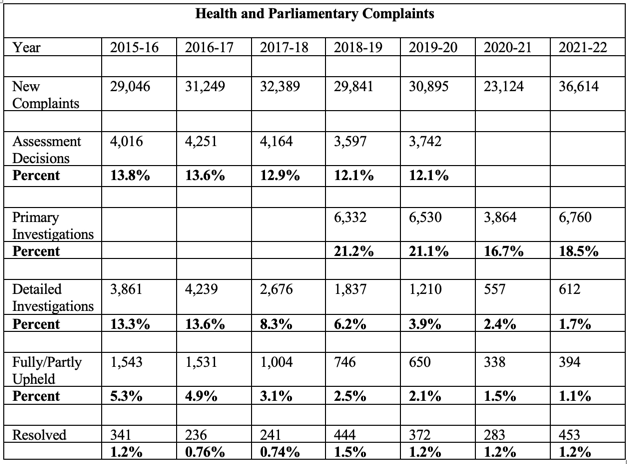
As the demand for service increased, Rob Behrens made it increasingly difficult for complainants to receive an independent investigation into their concerns. There has been recent criticism from the Public Administration and Constitutional Affairs Committee (PACAC) on the policy to close cases deemed to be ‘less serious’ in order to clear the backlog.
While it is positive that the PHSO’s backlog of cases has been brought down substantially this year, we are disappointed that its policy of not investigating health complaints deemed as less serious will continue for at least another year.
https://www.independent.co.uk/news/uk/parliamentary-and-health-service-ombudsman-mps-nhs-government-level-b2311372.html
Whilst failing to protect the rights of UK citizens to have an independent investigation, Behrens has been busy on the international scene and in 2019 became an International Ombudsman Institute (IOI) board member.
10.1 Elisabeth Davies congratulated Rob Behrens on his recent election to the Board of the International Ombudsman Institute (IOI), and all members echoed this.
10.2 Rob Behrens thanked members for their congratulations. He emphasised that his new role with the IOI is an opportunity to enhance comparative learning from other Ombudsman services around the world and bring it back to PHSO.
https://www.ombudsman.org.uk/sites/default/files/PHSO_Board_Approved_Open_Session_Minutes_12_December_2019.pdf
The IOI recognises the importance of the role of the Ombudsman on its website.
The role of Ombudsman institutions is to protect the people against violation of rights, abuse of powers, unfair decisions and maladministration. They play an increasingly important role in improving public administration while making the government’s actions more open and its administration more accountable to the public.
https://www.theioi.org/the-i-o-i
With its 1.1% uphold rate and 1.2% resolved rate, the Ombudsman failed to protect nearly 98% of the people who came to it for help in 2021/22. This would appear to be in direct conflict with the aims of the IOI. However, we learn from their strategic plan that their main priority is to promote themselves as the authoritative body worldwide (their emphasis).
The IOI will continue its efforts to increase its presence, enhance its influence, and strengthen its authority. As an organization, the IOI is the voice of Ombudsman institutions within the international community and it will continue its endeavours for recognition as the authoritative body on Ombudsman matters worldwide.
IOI achieve their aims via world conferences, research, training and the funding of regional projects. They gather cohesion via the Venice Principles, voted into approval in 2019.
The IOI will continue to advocate the effective application of the Venice Principles, as the internationally recognized standards for Ombudsman institutions. The IOI will work with members in their quest for continuing improvement. The IOI will assist members in reviewing their legislation in light of the Venice Principles and the UN Resolution on the Ombudsman through its peer review system, conferences and shared learning.
It is a global gang who prioritise the protection of their members over protection of their citizens. Is it therefore no wonder that one aspect of the Venice Principles provides them with total indemnity for their actions.

So how much time does Rob Behrens spend on his global power pursuits? We may have a more definitive answer when this FOI request is complete. Until then we can find a significant number of events listed on the Parliamentary and Health Service Ombudsman website. Indeed it would appear that much has happened in the IOI since the arrival of Rob Behrens – not least of which is the introduction of the Peer Review Process.
The original IOI best practice paper on ‘Guide to Peer Reviews’ was published in April 2020. The IOI ‘Guide to Peer Reviews’ was updated in March 2021.
To give further authority and independence to the Peer Review process, we have selected Dr Tom Frawley to assess peer review panelist applications and to advise the IOI European Board on their validation. The revised and entirely voluntary Peer Review process is now formally relaunched.
https://www.ombudsman.org.uk/sites/default/files/Manchester_TO_Athens_Paper.pdf
The peer review process gives fellow members reassurance and provides a buffer to external criticism. The weakness of peer review is the inherent conflict of interest. Hence the addition of Dr Tom Frawley to independently vet the review panelists. Yet, Dr Tom Frawley is anything but independent. He was Vice-President of the IOI in 2010 and has served as the Northern Ireland Ombudsman from 2000 to 2016. In January 2017 he was appointed by the Department of Health to be a Member of the Professional Standards Authority and is currently Chairman of the Western Health and Social Care Trust, Northern Ireland. He is a good old boy through and through. https://westerntrust.hscni.net/staff/dr-tom-frawley/
In 2018 Rob Behrens carried out a Value for Money Study, but when reporting the findings to PACAC, the committee was not convinced by the peer review process, suggesting that one ombudsman reviewing another ombudsman was ‘culturally cosy’.
Consequently, in the 2022 peer review Rob Behrens included academic, Professor Robert Thomas as the report’s author.
Chaired by Dr Andreas Pottakis (Panel Chair, Greek National Ombudsman and Chair of IOI European Board), with Mattanhayu Englman (State Comptroller and Ombudsman, Israel) Andrea Keenoy (Chief Operating Officer, Housing Ombudsman, UK), and Professor Robert Thomas (Professor of Public Law, University of Manchester, UK) report author.
https://www.ombudsman.org.uk/sites/default/files/PHSO%20peer%20review%202022_0.pdf
In February 2023 Professor Thomas posted data regarding the MP filter on the UKJAI website. Information had been released by PHSO showing that approximately 10% of MPs failed to refer any complaints to the Ombudsman on an annual basis. Parliamentary complaints require the support of the MP. In trying to determine whether the MP filter is effective, Professor Thomas stated;
The data does not tell us why a significant proportion of MPs do not any refer complaints or why some MPs refer one complaint whereas other MPs refer more complaints. It does not tell us about the regional variation or types of complaints or demographic factors involved. More work would be required to explore these issues. However, the variations are striking and unsettling. This seems to be a major contradiction at the centre of how the MP filter actually works in practice. Many MPs do not refer any complaints at all and many only refer a small number of complaints. In light of this, it is difficult to see how MPs use the filter effectively to hold government to account.
https://ukaji.org/2023/02/16/the-operation-of-the-mp-filter-for-complaining-to-the-parliamentary-and-health-service-ombudsman/
This data raises a valid debate with regard to the MP filter and Professor Thomas is surely the ideal person to identify the underlying cause. Could it be that a significant number of MPs see no value in submitting complaints to the Ombudsman? Given the very low investigation and uphold rate perhaps they are concerned about raising the expectations of their constituents. But academic research requires funding and that funding is usually via the Ombudsman’s budget. Whether peer review or research, if PHSO pays the bill they also call the tune.
Unsurprisingly, the 2022 peer review concluded;
This review finds that PHSO is now a substantially stronger organisation than it was at the time of the first peer review in 2018. It is an efficient, enhanced and effective modern Ombudsman service, which provides significant value for its stakeholders.
https://www.ombudsman.org.uk/sites/default/files/PHSO%20peer%20review%202022_0.pdf
No mention was made of the falling investigation rate which in 2022 stood at just 1.7% of all complaints.
Being a member of the IOI allows Rob Behrens plenty of scope for navel-gazing, as in the 2021 report The Art of the Ombudsman: leadership through international crisis.
With the backing of the international community, Behrens can also be a player on the world stage. Following a visit to Ukraine in December 2022, Rob Behrens was instrumental in the removal of the Russian Ombudsman from the IOI.
For me, and for PHSO, it was a great honour to be invited. As Vice-President of IOI Europe, I played an active role in arguing that the Russian Human Rights Commission (Ombudsman) was neither independent nor impartial and that it had become a mouthpiece for Kremlin views. After agonising debates at the IOI World Board we voted by 16 votes to nil in favour of its expulsion, with 4 abstentions.
https://www.ombudsman.org.uk/news-and-blog/blog/ombudsman-peril-rob-behrens-visits-ukraine
Unfortunately, the IOI became embroiled in some murky activities as the Ukrainian Ombudsman Lyudmyla Denisova was found to have released fabricated news stories about the conflict and Dmytro Lubinets was installed in her place. Following the visit Behrens and the IOI community changed their stance from neutral de-escalation (March 2022) to pro-Ukrainian, anti-Russian. As this article in UK Column points out – is it appropriate for the UK Ombudsman to be politically partisan?
Point 9 from the Venice Principles states;

‘Bound by self-regulatory codes of ethics’ kinda makes it ok I guess.
Another benefit of his membership is that he can use his international chums to put pressure on the UK government.
The UK Government has introduced new legislation, which excludes the Parliamentary and Health Service Ombudsman (PHSO) from access to “safe space” information collected by the Health Service Safety Investigations Body (HSSIB) from National Health Service (NHS) clinicians in England during its patient safety investigations. The Ombudsman will only be allowed to scrutinize these investigations if it receives the permission of the High Court in London.
https://www.theioi.org/ioi-news/current-news/support-for-parliamentary-and-health-service-ombudsman-uk
The International Ombudsman Institute strongly endorses the opinion of the Venice Commission. In an official statement of support, IOI President Chris Field, IOI Secretary General Werner Amon and European President Andreas Pottakis underline the importance of strong, independent Ombudsman offices as key elements of democracy and invite the relevant authorities to avoid any restrictions to the investigatory powers of the PHSO, as provided for in the Venice Principles.
In his own submission to parliament, the Ombudsman claims that this proposal will limit his ability to provide justice for patients who have been failed by the NHS.
The following statement gives the strongest indication of his key concern.
The proposed prohibition on PHSO accessing safe space could result in different accounts being given to PHSO during its own investigations that could not be reconciled without taking HSSIB to court. This would be the worst possible outcome for a patient who has already experienced a failing in care and treatment.
https://www.ombudsman.org.uk/sites/default/files/2022-01/Health%20and%20Care%20Bill%20Committee%20Stage%20Briefing%20-%20for%20organisations_1.pdf
As the ‘body of final resort’ the Ombudsman has access to all previous complaint reports. He is not in competition with any other investigative body which puts him in an ideal position to control the narrative. At all costs the Ombudsman wishes to avoid an ‘egg on the face’ situation such as that caused by James Titcombe who was able to demonstrate collusion between PHSO and CQC as both maneuvered to avoid investigating his serious complaint regarding maternity care at Morecambe Bay Hospital.
A memo obtained by Mr Titcombe purported to show that Mrs Hudson [deputy ombudsman] wrote to Ms Abraham [ombudsman] in September 2009 about a conversation the latter allegedly had with Cynthia Bower, then the chief executive of the CQC. It stated: “[The] suggestion arose that if we could assure Mr and Mrs Titcombe that as a result of their experiences CQC are now taking robust action to ensure improvements in the maternity services at the Trust, you might decide not to investigate.” Ms Abraham later told investigators she “would not have had an unminuted discussion with Cynthia Bower on such a serious matter along the lines suggested by [Mrs Hudson]”.
Kathryn Hudson was deputy head of the Parliamentary and Health Service Ombudsman (PHSO) during the Morecambe Bay hospital trust scandal, in which 11 babies died.
https://www.telegraph.co.uk/news/investigations/11892173/Regulator-who-cleared-Jack-Straw-let-us-down-over-baby-sons-death.html
After much media coverage, the Ombudsman Dame Julie Mellor finally investigated his complaint and found significant fault with the maternity provision. She did not, however, find evidence of collusion between the midwives to cover-up the avoidable death of his son Joshua at nine days old.
A later inquiry by Bill Kirkup in 2013 did however find significant evidence of collusion.
Kirkup said the reaction of staff in the maternity was shaped both by a denial that there was a problem and “a strong group mentality amongst midwives characterised as ‘the musketeers’”.
“We found clear evidence of distortion of the truth in responses to investigation, including particularly the supposed universal lack of knowledge of the significance of hypothermia in a newborn baby.”
The disappearance of certain records was of concern to Kirkup and his panel of experts.
The investigators found evidence of “inappropriate distortion” in the preparation for an inquest, with the circulation of “what we could only describe as model answers”. The report makes no criticism of staff for individual errors, but condemned incidents of collusion as both “inexcusable” and “unprofessional”.
https://www.theguardian.com/society/2015/mar/03/morecambe-bay-report-lethal-mix-problems-baby-deaths-cumbria
The more independent investigation of Bill Kirkup exposed the Ombudsman’s failure to identify the NHS cover-up. The Ombudsman was effectively protecting the midwives from further scrutiny and this was recognised by Mr Titcombe who criticised the PHSO for “identifying with the very people they were supposed to be investigating” and being unwilling to “ruffle feathers”.
Rob Behrens can see the danger in both PHSO and HSSIB producing reports into comparative complaints where he cannot ‘collude’ in their process to secure compatible outcomes.
A more intriguing question is, why has the government left the Ombudsman out in the cold?
To be continued …
 phsothetruestory
I note a comment on this thread that says PHSO does not need reform, but needs abolishing, and then a new body who will hold the NHS (and other orgs) to account.
Is that not inherently the same thing? Particularly if reform involves combining most of England’s ombudsman services into one and removing the MP filter.
Creating a new body (or reforming) doesn’t achieve the aims and hopes set out by people who have experienced a service they are not happy with. That is a cultural change that would be brought about by those in charge.
I agree with a reversal of the decision not to consider “lesser” complaints, to allow for everyone to be heard, but I do not think change is as straightforward as people like to claim.
Reform is required, and there will be a new Ombudsman this time next year, who (as you’ve mentioned on a previous post) will likely say a new broom sweeps clean etc and things will be different.
But it would be interesting to see a post about what people think a body such as PHSO (or any Ombudsman-type organisation) needs to do in future and how it achieves this. A difference of opinion or view cannot always be reconciled and you can see from reviews of any Ombudsman that the majority are unhappy.
LikeLike
When at the Cabinet Office some years ago, Chris Skidmore heralded a bill to create ‘A People’s Ombudsman’. That bill was seriously flawed and, fortunately, did not see the light of day due to lack of parliamentary time. In essence, I believe the bill was put forward as a consequence of serious criticism by the then Chief Executive of the Patients Association who appeared before the Health Select Committee.
The Ombudsman only has ‘soft power’. He can’t force anyone to do anything. As an example, I lodged a complaint against a mortgage company many years ago The Financial Ombudsman found in my favour and recommended a financial payment to me. The mortgage company took no notice and I had to take them to County Court who were the body that eventually made them pay up.
PHSO is just the same. The word Ombudsman has itself become synonymous with failure. A new body with real enforcement teeth is what is required. Insofar as health is concerned, we have Health Service Safety Investigation Branch, Care Quality Commission, PALS offices, NHS Trusts internal investigations and the like.
One overarching body, such as performed by the Independent Office of Police Conduct in respect of Police Services, but with real powers of sanction, would save the country millions of pounds currently spent on NHS litigation.
I appreciate this is only my personal view but clearly the current system does not work for the public
LikeLike
Thanks for your considered response.
I agree it would be much better if the Ombudsman, or any overarching body, had the powers to enforce action rather than “recommend”. Obviously the catch-all for that currently is supposed to be that any non-compliance with Ombudsman recommendations is laid before parliament to, hopefully, achieve the right outcome. Very few have needed to be laid before Parliament because organisations usually comply, but admittedly those bigger cases (such as WASPI when it’s finished, or a recent DWP case) are usually the only ones were you see that reluctance to comply.
I think all those organisations listed in the health sector (HSIB, CQC etc) also receive poor ‘reviews’ and lots of criticism so can’t be reliably used as a benchmark of anything to praise either.
I think many people think reform/change/or any other word describing what it the aim is, is what is needed. But that also includes PACAC, PHSO, and many others with their finger in the pie who also call for changes.
Hopefully we can see change materialise in the future.
LikeLike
The ombudsman achieves compliance by watering down the findings until they meet with approval. The primary issue with the ombudsman is that it is unaccountable and that breeds contempt for the public.
LikeLike
“The Ombudsman shall not, during his or her term of office, engage in political, administrative or professional activities incompatible with his or her independence or impartiality”.
This phrase was in the last PHSO Peer Review (Annex A point 9). The Peer Review, in this annex, described the Ombudsman as being FULLY CONSISTENT with these aims.
However, in my evidence to PACAC ahead of the last scrutiny session, I raised the point the Ombudsman had taken a role as the Chair of Governors at Anglia Ruskin University. I gave examples of how the perceived independence of the Ombudsman could be compromised by his university appointment (evidence reference PHSO020).
Whilst PACAC published my evidence, it failed to address the point in the oral scrutiny session of the Ombudsman on 29th November 2022 or make comment in its final report.
I wrote to Professor Robert Thomas on 25th November 2022 asking why the Peer Review considered the Ombudsman was fully consistent with the Venice Principle above.
Professor Thomas did reply outlining his understanding of the case law test relating to ‘apparent bias’. That was not really the point and, in an effort to get a definitive answer from Professor Thomas as to whether the Peer Review was aware, at the time of the review, that Mr. Behrens had taken the university appointment, I sought further clarification.
On 9th January 2023, he replied in one sentence:
“I think you need to contact the chair of the peer review panel”
So the peer review author expected me to write to the Greek Ombudsman to find out whether the peer review knew of the Anglia Ruskin appointment and, if so, why it considered our Parliamentary and Health Service Ombudsman to be compliant with the Venice Principle.
I prefer to expose the situation for the farce it is. This failed PHSO quango does not need reform. It needs to be abolished and replaced by a body that properly holds the NHS and Government Departments to account on behalf of the public.
LikeLike
For many poor people who have been treated badly by the NHS, things are only to get worse when they then complain to the PHSO. Without authority or consultation, Rob Brehans, of his own accord, decided to deny these complainants redress and large swathes of complaints began to be summarily struck off the PHSO’s books.
It fails me to see the purpose of the PHSO in return for the huge sums of public money it demands. Its standards of investigation are appalling going by people’s first had experiences and now it has decided not to investigate the vast majority of cases altogether.
When I raised a complaint with the Health Ombudsman, the NHS Trust’s CEO, Steve Trenchard, was mates with the Ombudsman’s MD, Mick Martin. They colluded to change the report from one that upheld my complaint into one that didn’t. Its open corruption:
LikeLike
The man is a serial loser and a joke not fit for for purpose as is the current Government. The amount of taxpayers money they have wasted is ……………….. BILIONS.
LikeLike