
How to rig an election:
At the Runcorn and Helsby election petition trial, the Deputy Returning Officer (DRO) stated that it would be impossible to rig an election, as far too many people would be involved and it would not be possible to do so undetected.
So how do you rig an election? You find the point of minimum contact.
At the Polling Station:
At the close of the poll, 10:00 pm, the Presiding Officer (PO) seals the ballot boxes with tamper-evident tape. They then complete the Ballot Paper Account, which is an accurate tally of issued ballots, those which are spoilt and those left unused, giving a total number for each box. They also prepare various Statements and Lists to include, voters assisted by companions (for disabilities), votes marked by PO (e.g. for illiterate voters) and postal votes delivered directly to the polling station. Also, the tendered votes list and the corresponding number list (which links voter I.D. to ballots) are prepared. All these documents are sealed in an envelope marked Electoral Register Finalised and delivered alongside the ballot boxes to be opened by the Returning Officer (RO) for verification purposes. The PO is observed at all times by other clerks, members of the public, candidates and their agents.
At the Counting Station:
The Deputy Returning Officer (DRO) at the petition trial described the Runcorn and Helsby ‘mini-count’ process in the following way: (See map below).
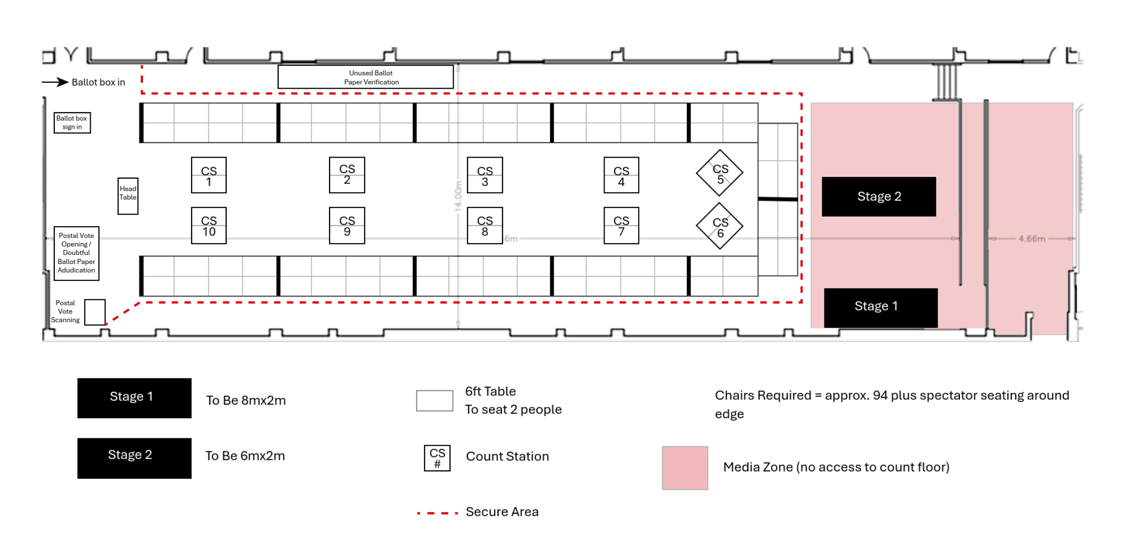
10 counting tables were set out in a rectangle around the room. The sealed paperwork was delivered to the RO, who was sitting at the head table. A set of smaller tables formed an inner circle and these were used for the storage of trays or the storage of ballot papers before and after counting.
Each ballot box was allocated to a specific table. On arrival, the seal on each box was broken in front of witnesses and the number of ballots was verified by clipping into sets of 10 and then into bundles of 100. Once complete, the total for each box was presented to the RO via a count supervisor. The RO said ‘yes’ if the numbers matched or ‘no’ if not. Only the RO and possibly the DRO know the numbers for each box and the total number of ballots across the count.
Once verification was agreed, the ballots were then mixed in a central location to ‘maintain secrecy’. (This allows the postal votes to be mixed with the main vote. If the postal vote had been tampered with, the swing would not match that of the main vote if recorded separately.)
The DRO explained that after mixing in the central area, the ballot papers did not move from their assigned counting tables for security. A ballot would only be removed from the allocated table if considered to be doubtful. These were taken to the RO for a decision and an IOU was left at the table in their place.
In Runcorn and Helsby, the votes were initially sorted into five trays. One for each of the main parties, Labour, Conservative and Reform, one for ‘other’ and one tray for doubtful ballot papers. The votes for each main party candidate were clipped into 10, then into bundles of 100. This process was double-checked by colleagues sitting alongside. Flick checks were used to ensure that all the votes in a bundle were for the same candidate. The DRO explained that once all the ballots were counted, the totals went back to the Head Numerator, but did not give a name for this person. In many instances, the Head Numerator is also the Returning Officer or a person appointed by the Returning Officer. The Head Numerator or Returning Officer then enters the totals for each candidate onto a computer spreadsheet. In Runcorn and Helsby, the RO was Stephen Young.
The completed trays were then stored in the central area while the ‘other’ candidate ballots were counted. In the Runcorn and Helsby by-election, this required 12 trays plus a doubtful tray. The votes were counted in the same way, by clipping 10 and then making bundles of 100. Odd numbers were clipped with a Post-it note saying how many were in the bundle, i.e. 7. The counting was checked and double-checked while candidates and agents looked on. The final tally was then taken to the Head Numerator or RO for entry onto the spreadsheet.
Once the count was complete, the ballot papers remained in the named candidate trays, spread around the room. The votes for individual candidates were not collected into one place where observers could estimate their total. The RO uses the spreadsheet figures to announce the outcome. Providing the total number of counted votes matches the total number of verified ballots, the spreadsheet can be signed off as an accurate record. According to the map, the RO and DRO sit at one end of the room, furthest from the press. Observers are not allowed to cross the red dotted line, so there is no observer scrutiny of input onto the spreadsheet. Only a few members of the electoral team are given access to this part of the room.
There was no clear description given of the security measures taken to ensure the accuracy of the spreadsheet at the trial. A possible check and balance could be via two computers with two different people collating the data. When both spreadsheets fail to tally, an alert is highlighted for the attention of the data handlers. The spreadsheets are downloaded from the Electoral Commission with automatic cell calculations built in. They are, in theory, used ‘offline’ to prevent tampering. If both individuals decided to flip votes from one candidate to another, would anyone notice? Is it be possible for a remote party to flip the vote on the spreadsheet without detection? This is the point of minimum contact.
At the end of the count, all paper records are sealed and delivered to the Electoral Registration Officer (ERO) to be securely stored for 12 months along with the sealed ballot papers. In the case of Runcorn and Helsby, Stephen Young was both the RO and the ERO, so he effectively sent the paperwork to himself. If there is any curiosity after the count, the ERO is the only person with access to the paperwork, but the sealed envelopes cannot be opened without a court order, which means that you have to prove your case in order to reveal the evidence.
 phsothetruestory