

There are winners and losers when it comes to government compensation schemes.
On 18.2.26, a BBC headline announced;
Firm assessing Covid vaccine harm replaced after costs spiral to £48m
Nearly £50m of taxpayers’ money has been paid by the NHS to an outsourced firm assessing claims of medical harm caused by vaccines, the BBC has found.
The figure is eight times the amount originally estimated for the assessment work carried out by Crawford & Company Adjusters – and almost £20m more than the total so far awarded to those injured or bereaved as a result of Covid vaccines.
The clear winners in this case are the privately outsourced company that managed to skim nearly £50m from the compensation package, while injured victims continue to wait for financial support.
The administrators of such schemes are salaried, so it matters not to them how much time is taken. They can always exlain away delays with an earnest ‘we need to get things right’.
Which brings us to the Infected Blood Compensation Scheme (IBCA). Going back as far as the 1970’s, the victims of this scandal have already waited a considerable time. The IBCA was set up in May 2024, following the publication of the final Inquiry Report. Twelve notable individuals sit on the committee, including the previous Parliamentary and Health Service Ombudsman, Rob Behrens and up until her recent appointment, the new Ombudsman, Paula Sussex. Why so many?

In July 2025, Rob Behrens reposted the following statement from the IBCA on his X account.
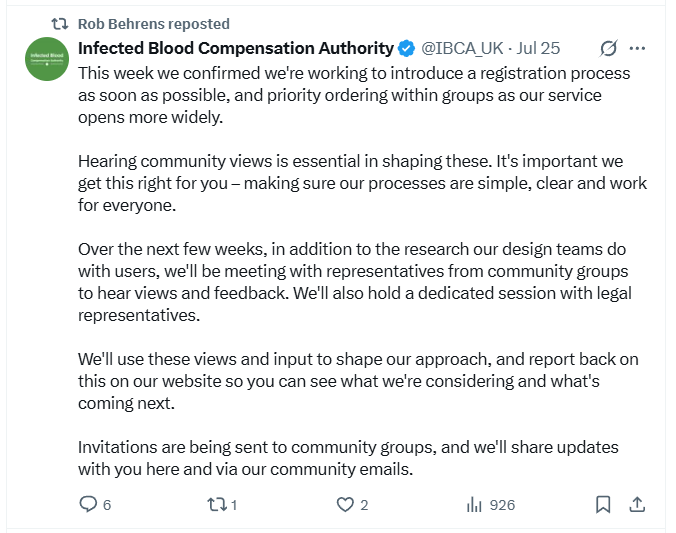
Over a year later and the commitee are still considering ways to introduce a registration process. This update was not well-received by those who continue to suffer from debilitating health conditions.




Three months later, in October 2025, an audit of the Cabinet Office Accounts is qualified by the Comptroller and Auditor General due to, among other things, delays with the Infected Blood Compensation Scheme.,

The Comptroller and Auditor General issued a qualified opinion on the Cabinet Office’s 2024-25 accounts because there was insufficient evidence for £6,987 million of the £9,582 million provision for the Infected Blood Compensation Scheme.
Why I was unable to obtain sufficient appropriate evidence
As at 31 March 2025 the Infected Blood Compensation Authority had not opened its claim service for infected individuals not yet registered, the estates of infected individuals who have died, and affected individuals. The infancy of the Compensation Scheme means there is minimal historic data available, if any, for these three cohorts, and the Infected Blood Compensation Authority and Departmental Group has not provided sufficient evidence to support its key assumptions on the number of expected claimants. The key assumptions on claimant volumes have a material impact on the provisions calculated and therefore I limited the scope of my audit opinion in relation to £6,987 million of the £9,582 million Infected Blood Compensation Scheme provisions.
The intervention of the Ombudsman was in the nature of speeding up the process in the public interest.
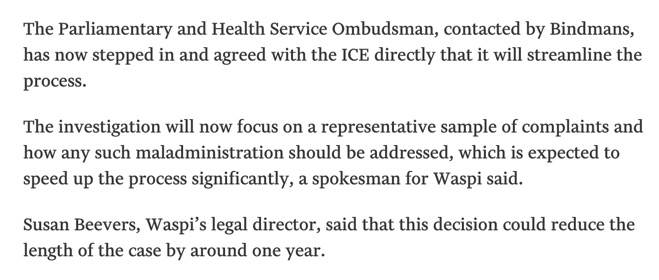
However, due to various delays and the decision to issue two final reports instead of one, the matter consumed the whole of Rob Behrens’ tenure, with the final report issued just as he took retirement, in March 2024.
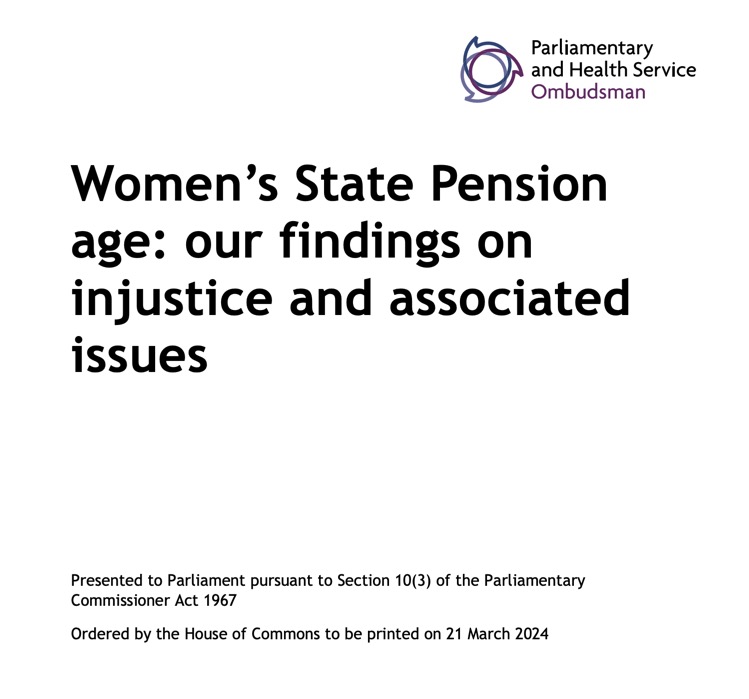

The WASPI women waited in hope for seven long years. However, as the Ombudsman has no powers of compliance, the long-awaited findings were simply ignored by the government, who refused to pay the meagre compensation suggested. The winner here was clearly the Ombudsman, who managed to spin the crisis out and walk away from the fallout. The Ombudsman had done a good job of minimising the harm caused by the 15 year delay, allowing the government to state that most women were not affected. A neat trick you can see below.
Then, out of the blue, Rob Behrens becomes Sir Robert Behrens, courtesy of the King’s Birthday Honours list.
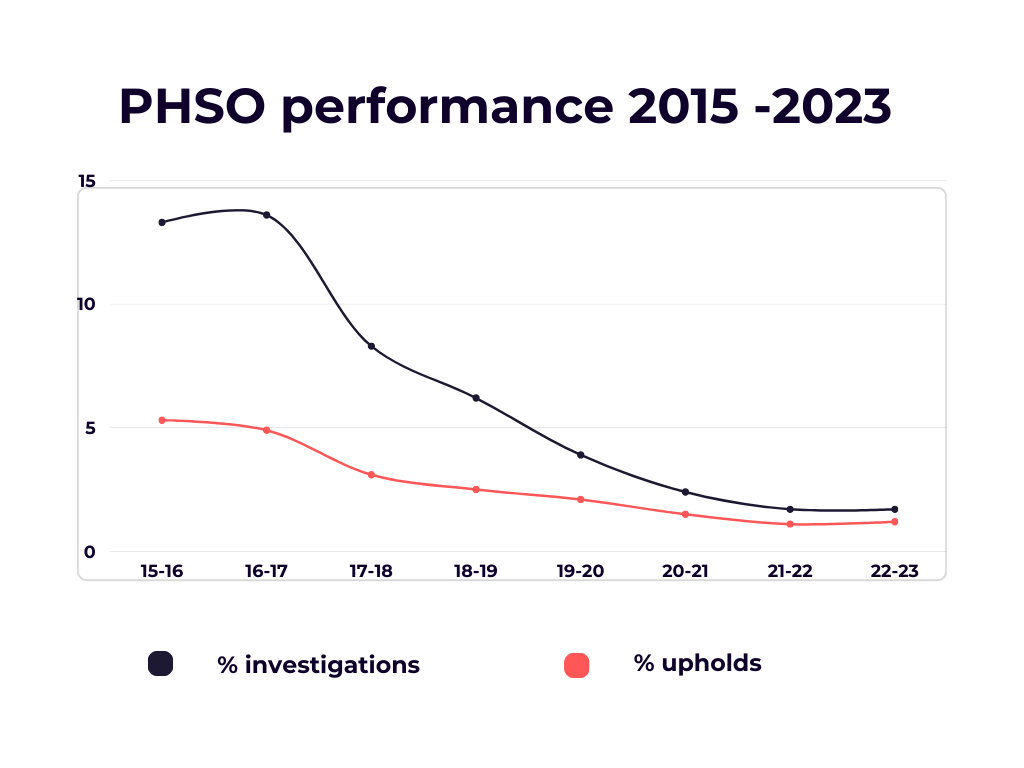
He was recognised for public service and in particular his service as Ombudsman. A number of ‘his achievments’ were mentioned in the article but it ommited to inform that onced Behrens took over the role in 2017, he systematically reduced the number of cases investigated and upheld year on year. It is difficult see how a reduction in access to justice can be described as a ‘public service’ but it has saved the state a lot of trouble.
If they ever get a compensation scheme for the victims of the grooming gangs, no doubt some of the ‘great and the good’ will take their time to consider all the variables as they are handsomly rewarded for their time and diligence. The never-ending gravy train. The ultimate winner, every time, is the government of the day, who do the harm, defend against an inquiry, then spin out the compensation process hoping that the victims will pass away before they receive payment. Ill gotten gains on the backs of the most vulnerable.
 phsothetruestory
I have just watched all three episodes of ‘Dirty Business’ on Channel 4. Although it relates to the privatised water industry, it encapsulates everything experienced by the public in all forms of ‘regulatory oversight’. Well worth watching
LikeLike
I wonder just how many ‘Public Enquires’ are in progress? And how much collectively they have cost annually….so far.
LikeLike
When they start getting criticism they spend even more money on a PR company to counter the negative comments. https://www.prweek.co.uk/
LikeLike
It is hard to believe it is anything but deliberate that the issue of recompense for victims (infected blood) is still dragging its feet. Thanks for returning to this.
A similar scandal (infected blood) appears to run parallel in Australia and revelations about a coverup may be about to break – just a 6 minute watch
https://x.com/i/status/2026444674647601578
LikeLike
There are so many committees, groups, authorities etc, chaired by the great and good, with grand titles, and yet nothing seems to get done. It doesn’t take months to introduce a registration process or even seven years to produce a report on the women’s pension issue. There is no incentive for them to adopt deadlines or act with urgency and so they don’t. There should be financial penalties and tight deadlines for these organisations and then they might work a bit harder and produce more results.
LikeLike
From the scandal of the ‘infected blood’ debacle of the seventies, to the Waspi women and right through to the experimental Covid Vaccines, the establishment always protects itself from any wrongdoing, and rewards those who do the bidding of the deep state. How can so many be scuppered by so few? and now in plain sight, thanks to the same internet ‘they’ are trying to control us with.
LikeLike