
As part of their 10-year plan for the NHS, the government have announced a Review of Patient Safety, which was initially triggered by the Review of the Care Quality Commission completed by Dr Dash in September 2024. In March 2025, Dr Penelope Dash became the new Chair of NHS England.
According to a DHSC statement delivered to the House of Lords on 7th July by Baroness Merron, a reorganisation of the patient complaint landscape will provide substantial benefits. (pages 2/3)
These changes will improve quality, including safety, by making it clear where responsibility and accountability sits at all levels of the system, and making it easier for staff, patients and users to directly feed into the system to improve quality of care.
Of course, the voice of the patient and that of the whistleblower will be at the heart of the process.
Patient and staff voice should not be kept at arm’s length but be at the heart of everything the NHS does.
Don’t get too excited. It has been decided that many of the patient safety bodies, which have largely sprung up in response to previous NHS scandals, are to be incorporated under the watchful eye of the Department of Health and Social Care, or report directly to another government quango.
Dr Dash made nine recommendations, which have all been accepted by the government.

HSSIB – Health Services Safety Investigation Body began life in 2017 as the Healthcare Safety Investigation Branch (HSIB.) Keith Conradi was selected to bring into the NHS the successful ‘no fault’ investigation methods used in the Air Industry. It can be seen in the case of Baby Harry Richford that HSIB were the only organisation to carry out a thorough review and reveal the truth. Conradi constantly fought with NHS England bosses and the DHSC, who appeared to have their ‘priorities elsewhere’.
So, HSSIB reports to CQC, who report to DHSC, who do what exactly? There is no independence in this structure, with reports ending up on the perpetrator’s desk so that they can more easily control the narrative.
The Patient Safety Commissioner reports directly to the Medicines and Healthcare products Regulatory Agency (MHRA), which has approved the drugs that are reported to have caused harm. They, of course, will hold themselves to account.
Local Healthwatch, born from the 2012 Health and Social Care Act to strengthen the voice of the patient, will now report directly into a DHSC silo. Alongside The National Guardian, introduced after the Sir Robert Francis Freedom to Speak Up Report in 2016, to amplify the voice of concerned NHS staff.
PALS – the Patient Advice and Liaison Service, who are employed by individual NHS Trusts as the first point for patient complaints, were not part of this review. Neither was the PHSO – Parliamentary and Health Service Ombudsman, who acts as the ‘last resort’ when all other complaint avenues have been exhausted. Presumably, the government are not concerned about the function of these bodies, as no reform has been put forward. All they have done is put the middlemen under the direct control of the government, then told us that this will improve patient safety.
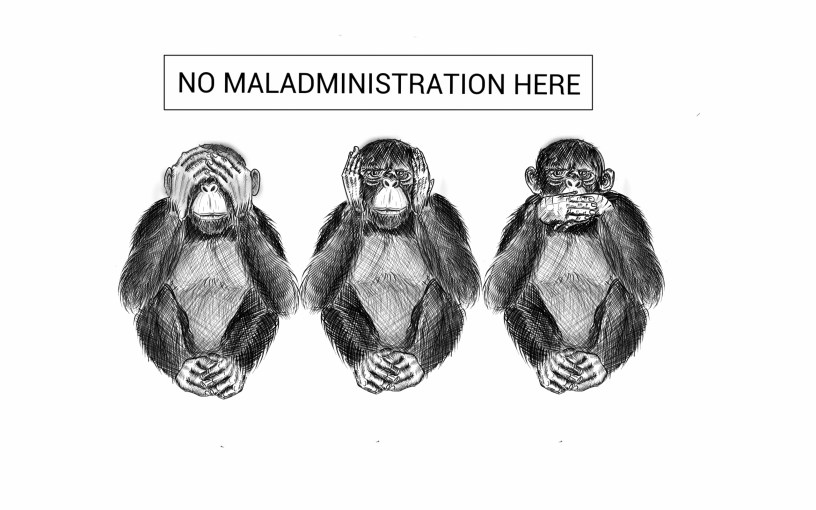
This government and previous governments have perfected the brass monkey response to bad news and this reform simply makes it easier for them to bury the evidence and silence the complaining voices.

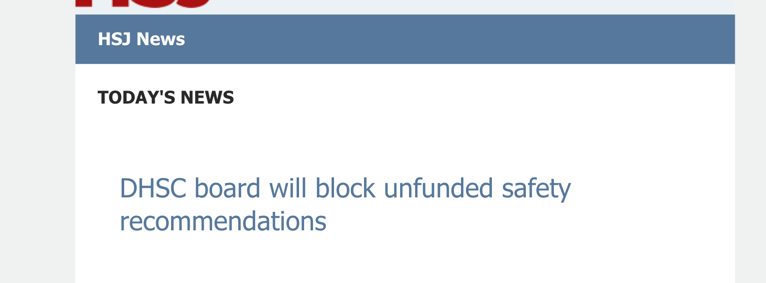
I’ll just leave this here: Recent headline from Health Service Journal.
 phsothetruestory
Dismaying that independence appears at risk. Your sensitive data (now more widely shared (due to the cosying up of organisations) could be seized upon by a body under criticism. Exploiting your data could help shut down your case before the merits have been properly explored.
Thanks for keeping us up to date. Let’s watch how this goes.
LikeLike
So they can continue with oudles of places for patients to enquire for help on safety issues with no one doing anything. Perhaps they’re sort of scaling it down on view of the current book balancing quest.
I found a PHSO document from June 2023 ‘Broken Trust – making patient safety more than just a promise’ 🤣
LikeLike
I could paper my walls with the patient safety propaganda put out over the last decade. All of it totally meaningless.
LikeLike
Taking your article in conjunction with my own which you published earlier this week, it is now clear it will be even more difficult for the patients voice to be heard.
I suppose one form of measurement of the 10 year plan would be to see a decrease, over the 10 years, in the number of inquiries (as per page 85 of the plan and highlighted in my article) needed to highlight the failings within the NHS. Now the Department of Health is taking all the ‘watchdogs’ in house (PHSO and LGSCO.conveniently excepted) we might well see that decrease. However, I am yet to be convinced about real future change in patient satisfaction – it will just be less easy to expose.
LikeLike
Dear Della,
Thank you.
‘control the narrative’ aka cover up.
What Patient Safety is that?
I have solid evidence, of what started as a formal complaint and took four years to try and navigate, resulting in insincere paper apologies which I regarded as a complete insult.
Absolutely no accountability in the smallest form.
A part PHSO uphold from a ridiculous unregulated incompetent cover up organisation, which I now do not acknowledge at all.
Hundreds of back and forth emails twisting the narrative to get the result they wanted. Ending with this.
—- Forwarded message —–
From:@ombudsman.org.uk>
To: Forsey
Sent: Tuesday, 28 May 2019, 09:46:04 BST
Subject: RE: Explanation of final PHSO review request
Dear Mrs Forsey,
I understand your complaint has had a massive effect on you and I am sorry for this. You are aware of the parameters within which the Ombudsman works and particularly my role of reviewer, as this is about our decision.
After you decided to publically rip into my letter on social media I do not feel inclined to respond further.
Yours sincerely
As well bullying from the Trust, CQC, GMC,PHSO Dept Health, Avon & Somerset police to cover up a shocking death.
How can anyone who complains expect to get through or even survive that gauntlet?
I would be interested to know if any of the above organisations are monitoring my comments.
Moving on from 2016 to 2021 the death of my husband.
Where is the learning?
We were abandoned by the Trust as it was during Covid.
‘New’ drugs still on trial recommended by Nice as a first line of defence against kidney cancer.
The first infusion stopped him walking, second infusion stopped him breathing.
Investigation followed by Yellow Card MHRA and Merk.
I am not allowed to see.
I note point 4 of Dr Dash’s recommendations. Transferring Patient Safety Commission to MHRA! to another cover up dept, just who makes all of this up!
The amounts of money Govt paid Merk at a discount to experiment on our folk are eyewatering!
I don’t trust one of them Della, they will find a way to get out of any wrong doing with another review, another recommendation, another Govt.
I asked once is there anyone out there?
I hate to say it, but there is no one.
LikeLike